How to Light a Bulb with a Battery: Step-by-Step Guide
Learn how to safely light a bulb with a battery, explore basic circuit concepts, and avoid common mistakes with practical, beginner-friendly steps from Bulb Fix.


With a battery, a bulb, and a few insulated wires, you can build a simple circuit that lights the bulb. This guide helps you understand safe, low-power setups suitable for learning. You’ll learn about basic circuit concepts, why a complete loop matters, and how to avoid short circuits while keeping experiments gentle on components. According to Bulb Fix, safety comes first.
Understanding the Basics of Lighting a Bulb with a Battery
Lighting a bulb with a battery is a hands-on way to see a simple electrical circuit in action. Even a tiny, safe setup can demonstrate how energy flows from a power source, through a conductor, and into a load such as a bulb. This kind of experiment is ideal for beginners who want to visualize voltage, current, and resistance without complex equipment. According to Bulb Fix, the simplest learning experiences emphasize safety and controlled parameters. A well-designed, low-voltage arrangement reduces heat, minimizes risk, and keeps the focus on core concepts like a closed loop and proper polarity. In this section we’ll break down the components you’ll typically use, why each part matters, and how to think about the circuit as a single path of energy from battery positive to the bulb and back to the battery negative. We’ll also touch on why understanding LEDs vs incandescent bulbs matters for safety and energy use.
This foundational knowledge helps you progress from a basic “what happens if I connect this?” moment to a structured, repeatable experiment. By framing the activity as a safe learning exercise, you’ll gain confidence handling power sources and measuring outcomes. Bulb Fix’s approach emphasizes keeping the voltages low and the connections secure, so you stay focused on the science rather than fear of shocks or fires. As you read, think about the circuit as a loop with three essential parts: a power source, a conductive path, and a load that converts electrical energy into visible light. Only when all three are connected do you see the bulb glow.
A quick note on terminology: voltage is the push that moves electrons, current is the flow, and resistance is what controls how much current travels through the bulb. The same framework applies whether you use a tiny flashlight bulb or a modern LED. Keep this mental model in mind as you explore different configurations and learn what works best for your materials.
Choosing the Right Components
Selecting the right components sets the stage for a safe, educational experience. For beginners, start with a low-voltage battery such as an AA or AAA cell or a small 9-volt battery if you pair it with a suitable low-current bulb. The bulb choice matters: an incandescent flashlight bulb is a classic demo load, while an LED with a resistor demonstrates current limiting—an important safety concept for any circuit. Wires should be insulated copper, ideally 22–24 AWG, with stripped ends to ensure a solid contact. Look for short, flexible lengths (6–12 inches per lead is plenty for a tabletop setup) and avoid frayed insulation. A simple bulb holder or alligator clip connections can reduce the chance of loose contacts that cause intermittent lighting. Keep a roll of electrical tape to insulate exposed connections and prevent accidental shorts. If you’re using LEDs, you’ll often need a resistor to limit current; otherwise, the LED can burn out quickly. Finally, have a basic multimeter on hand to verify voltage and continuity. This combination fosters a controlled, observable experiment rather than a risky, improvised one. Bulb Fix recommends starting with LED-based demonstrations when possible, as these are more forgiving for beginners and easier to quantify.
Safe, Beginner-Friendly Setups
There are two safe, beginner-friendly routes for this activity. The first uses a low-voltage incandescent bulb with a small battery: keep the battery voltage minimal, use short leads, and avoid touching metal tools to terminals while the circuit is live. The second route uses an LED with a current-limiting resistor in series; this approach teaches the same circuit concepts while protecting the diode from excessive current. In both cases, use a bulb holder or sturdy clips to secure every connection, and always insulate any exposed metal. For LEDs, calculate a safe current using Ohm’s law and select a resistor accordingly (for a typical 3V LED with a 9V source, you’d choose a resistor that limits current to around 10–20
How Current, Voltage, and Resistance Shape Brightness
Understanding the interplay of current, voltage, and resistance helps you predict how bright a bulb will glow in a battery-powered setup. In a simple circuit, voltage is the energy pushing electrons, current is the flow of electrons, and resistance is what restricts that flow. An incandescent bulb relies on the filament’s resistance to convert electrical energy into light and heat; the brightness rises with current, which increases with higher voltage or lower resistance. LEDs behave differently: they have a relatively fixed forward voltage and require current limiting. Without a resistor, an LED connected directly to a high-voltage source can burn out quickly. When you mix a battery, a bulb, and a resistor (for LED experiments), you can explore how brightness changes as you alter resistor values or battery types. A helpful rule of thumb is to start with a conservative resistor value and adjust upward if the LED glows dim or off, then reduce slightly if you aim for stronger brightness. Visualizing these relationships reinforces that a circuit’s “load” (the bulb) converts electrical energy into light; the rest of the system (the battery and wires) simply supplies and carries that energy. Bulb Fix emphasizes that this is a learning exercise, not a high-power project, so keep expectations modest and safe.
Common Mistakes and Troubleshooting
Even experienced learners encounter hurdles when lighting a bulb with a battery, but most issues have straightforward fixes. A frequent problem is a loose connection: gently crimp or twist wire ends to ensure solid contact at the terminal or clip. Another common issue is a dead battery, so test voltage with a multimeter or substitute a fresh cell to confirm power availability. If the bulb doesn’t light, check polarity for LEDs (anode to the positive terminal) and inspect any resistor values you used; incorrect values can prevent illumination or burn out the LED. Short circuits—where wires touch directly without a load in between—produce heat and can drain the battery quickly; prevent this by keeping all exposed conductor surfaces insulated and using clips or a holder to isolate components. For incandescent bulbs, ensure the filament isn’t broken and that the bulb is properly seated in its holder if you’re using one. If the bulb glows weakly, verify the battery’s capability to supply sufficient current and, if necessary, increase contact quality and reduce resistance slightly. Finally, store components in a dry place away from metal objects that could bridge contacts. This systematic approach helps you quickly identify the root cause and restore a reliable test circuit. Bulb Fix reminds readers to pause and reassess safety whenever anything feels “hot” or unstable, and to avoid improvising power sources beyond recommended limits.
Extensions: Moving from the Bench to a Tiny Breadboard
Once you’re comfortable with a basic battery-to-bulb setup, you can extend the learning by using a tiny breadboard, a single LED, a resistor, and a low-voltage power supply. This move introduces you to breadboarding fundamentals, including how to place components, how to route wires, and how to use a multimeter for measuring current and voltage in a live circuit. A breadboard both protects components and makes repeat testing efficient, which is ideal for experiments that compare different resistor values or bulb-types. Start with a 3V LED and a resistor in the 220–470 ohm range, then experiment with different values to observe brightness changes. As you advance, you can explore more complex circuits, such as series and parallel arrangements, to see how brightness and current distribution shift across multiple bulbs or LEDs. Throughout this process, maintain strict safety habits: unplug power before rearranging components, inspect connections for sharp edges, and use eye protection when handling live circuits. With practice, you’ll gain a concrete understanding of how simple elementary components combine to form a functional electrical system. Bulb Fix encourages learners to document observations, record resistor values and voltages, and compare results to strengthen their intuition about circuit behavior.
Tools & Materials
- Battery (AA/AAA or small 9V)(Choose low-voltage source for safety; ensure the battery is fresh and not swollen.)
- Light bulb (incandescent or LED with resistor)(Incandescent bulbs show brightness changes with current; LEDs require current limiting.)
- Insulated copper wires (22–24 AWG)(6–12 inches per lead; stripped ends for good contact.)
- Electrical tape(For insulating exposed conductors and securing connections.)
- Bulb holder or alligator clips(Optional but improves contact reliability.)
- Resistor (220Ω–1kΩ for LEDs)(Needed to limit current for LEDs; not required for basic incandescent setups.)
- Multimeter(Use to verify voltage and continuity.)
- Safety goggles(Eye protection during hands-on experiments.)
Steps
Estimated time: 15-25 minutes
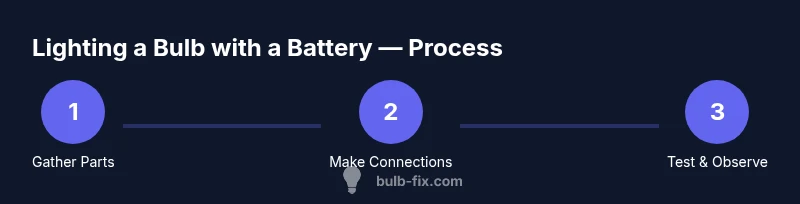
- 1
Gather and inspect materials
Lay out all components and check each item for safety. Inspect wires for nicks, test bulbs for visible damage, and confirm the battery is not swollen. This ensures a stable, predictable setup before you begin.
Tip: Double-check that insulation is intact and that there are no loose metal fragments near the workspace. - 2
Prepare workspace and safety
Clear a non-conductive surface, lay a protective mat, and wear safety goggles. Keep liquids away from the setup, and have a plan to power down quickly if something goes wrong.
Tip: Avoid metal jewelry near the circuit to reduce the risk of accidental shorts. - 3
Connect one wire to the battery terminal
Attach one stripped wire end to the positive terminal of the battery using a clip or by wrapping securely. Ensure a firm contact without letting the wire touch other metal surfaces.
Tip: Secure the connection so it won’t easily detach during testing. - 4
Attach the bulb leads
Connect the other stripped wire end to one terminal of the bulb or bulb holder. If you’re using a LED, insert the resistor in series to limit current and prevent damage.
Tip: If using a LED, verify correct polarity (anode to positive). - 5
Complete the loop and observe
Connect the remaining wire end to the bulb’s other terminal to complete the circuit. If the bulb lights, observe brightness and note any warm-up behavior. If it doesn’t light, recheck connections and battery charge.
Tip: Take quick voltage readings with your multimeter if available to confirm current flow. - 6
Power down and clean up
Remove wires and safely detach components. Store pieces in a dry, non-conductive container and dispose of any damaged parts properly.
Tip: Wipe down the workspace and unplug any tools before putting materials away.
Got Questions?
Is it safe to light a bulb with a battery at home?
Yes, when you use low-voltage sources, insulating materials, and secure connections. Avoid high-current batteries and short circuits. Do the activity calmly and follow safety conventions.
Yes, as long as you use low voltage and proper safety steps, avoid shorts.
What kind of battery should I use for beginners?
A fresh AA or AAA cell or a small 9-volt battery is a good starting point when paired with a small incandescent bulb or LED with a resistor. Avoid using large, high-current sources until you’re comfortable with the setup.
A fresh AA or AAA battery works well for beginners.
Do I need a resistor for incandescent bulbs?
Incandescent bulbs typically don’t require a resistor for basic demonstrations, but LEDs always do to limit current and avoid damage.
LEDs always need a resistor; incandescent bulbs usually don’t, in simple demos.
What mistakes are most common?
Loose connections, dead batteries, and accidental shorts are the main culprits. Double-check contacts and ensure insulation before powering the circuit.
Common problems are loose contacts and shorts; check connections first.
Can I use a breadboard for this experiment?
Yes. A breadboard makes connections easier and safer, and lets you swap components quickly to compare brightness and current flow.
A breadboard is a great next step for safer testing and quick changes.
What should I do if the bulb gets hot?
If the bulb heats up unusually, power down and check the battery voltage and connections. Overheating can indicate too much current or a faulty bulb.
If it heats up, stop and check your connections and voltage.
Watch Video
Key Points
- Always ensure a complete circuit before testing.
- Start with low voltage and safe components to reduce risk.
- Use current-limiting resistance for LEDs to protect them.
- Stay organized and disconnect power before modifying the circuit.