Tail Light Replacement Cost Guide: What to Expect in 2026
Understand tail light replacement cost in 2026 with a clear breakdown of bulb types, labor, and DIY vs pro options. Learn how to estimate, compare quotes, and save on parts and labor.


Tail light replacement cost typically ranges from about $10 to $200 per bulb when factoring parts and professional labor, depending on bulb type (halogen vs LED module), vehicle make, and local rates. DIY replacements cost only the bulb price, while LED module replacements may require whole assemblies, raising total costs.
Why tail light costs vary
Tail light replacement cost is not a fixed number; it shifts with several key factors. According to Bulb Fix, the most influential drivers are the bulb type (incandescent vs LED module), accessibility of the tail light, and whether you replace just the bulb or the entire assembly. In many vehicles, the tail light sits behind panels or deep within a sealed housing, which inflates labor time and can complicate resealing after service. The phrase tail light bulb replacement cost captures parts and labor, but it omits the reality that some models require extra steps for removal, testing, and reassembly. As car designs move toward LED-tail-light technology, the cost picture often changes from a simple bulb swap to module or housing replacement, which is a core reason why two similar cars can have noticeably different repair bills.
For DIY enthusiasts, the cost dynamic also depends on your tool set, access to the bulb socket, and whether you need a sealing gasket or new cover. Bulb Fix’s data for 2026 shows that the price range broadens significantly when newer vehicles rely on LED or modular components rather than traditional incandescent bulbs.
How bulb type affects price and complexity
Bulbs come in several forms: incandescent/tail-light bulbs, LED modules, and full LED assemblies. Incandescent replacements tend to be the least expensive part, with simple bulb swaps often completing in under an hour. LED modules, while more durable, bring higher part costs and specialized installation steps. Some LEDs are modular (one replaceable unit) whereas others are integrated with the housing, demanding careful alignment and protective sealing during replacement. Full assembly replacements are the most costly option, as they include the entire housing, wiring, and seals. In practice, the design chosen by the vehicle manufacturer largely dictates both parts cost and labor time. For many vehicles, LED modules require precise water sealing and proper optical alignment to meet safety and regulatory standards, contributing to higher labor costs.
Accessibility and labor: the hidden price lever
The physical location and accessibility of the tail light assembly have a direct impact on labor time and cost. In some cars, you can reach the bulb without removing trim or bumper components; in others, you may need to lift the vehicle, detach fender liners, or remove sections of the bumper to access the socket. Labor time scales with the number of fasteners, the ease of unplugging electrical connectors, and the number of protective layers that must be removed and reinstalled. Even seemingly minor details—like needing to reapply sealant or test the circuit after replacement—add incremental costs. For this reason, two shops in the same city can quote different total costs for identical-sounding work. Bulb Fix’s 2026 analysis highlights that accessibility is often the most variable factor in price.
DIY vs professional replacement: weighing the options
DIY tail light bulb replacement is appealing for those who enjoy a hands-on fix and want to minimize labor fees. If you replace only a standard incandescent bulb, you may pay little beyond the bulb itself. However, if you work on LED modules or an entire housing, DIY becomes riskier due to the potential for water intrusion, misalignment, or damaging electrical connectors. Professional replacements provide the benefit of guaranteed sealing and tested operation, along with proper diagnostics for related tail light circuitry. When LED modules or integrated assemblies are involved, many shops will recommend a professional installation to ensure safety and compliance with applicable regulations. The decision often comes down to your comfort level, the vehicle’s design, and the specific part required.
LED tail lights and assemblies: when costs spike
Modern vehicles increasingly rely on LED tail lights, which can dramatically alter replacement economics. Replacing a single incandescent bulb remains cheap, but LED modules and full LED assemblies can push total costs higher due to specialized parts and precise calibration requirements. In many cases, LED modules are replaced as a unit, rather than swapping a single diode, which increases both part cost and labor time. When the entire tail light housing must be replaced, you should expect a substantial jump in price because the housing, wiring harness, seals, and lenses must all be considered. As a rule of thumb, plan for higher costs on vehicles with newer LED-based tail light designs. Bulb Fix Analysis, 2026 indicates that LED-related replacements are the fastest-growing contributor to tail light repair costs.
How to get an accurate estimate and plan ahead
To estimate accurately, start by identifying the exact bulb type and the model of your vehicle. Compare quotes from at least two reputable shops, asking for a line-item breakdown that separates parts, labor, and any service fees. Request a written estimate before service and ensure it includes the cost of any seals, gaskets, or extra hardware. If your vehicle uses an LED module or full assembly, inquire about warranty coverage and the expected lifespan of the replacement. Finally, consider the potential need for wiring diagnostics or recalibration after installation, which some repairs may require. A well-documented estimate helps you avoid surprise fees and makes it easier to budget for the repair.
Cost-saving tips and best practices
- Check whether your bill includes the cost of resealing and water intrusion testing.
- If you’re comfortable, consider replacing incandescent bulbs yourself to save on labor.
- Compare prices for parts from aftermarket suppliers and original equipment manufacturers (OEM) when appropriate.
- Ask about bundled services, such as inspecting other exterior lights, to maximize value.
- Maintain your tail light seals and housings to minimize future repair costs by preventing moisture ingress.
Real-world scenarios and quick reference checks
- Scenario A: A 2015 sedan with incandescent tail lights, easy access, DIY replacement possible. Total cost is mainly the bulb price, under $20.
- Scenario B: A 2018 SUV with LED module tail lights that require a module swap. Total cost often exceeds $150 and can reach $300 or more if labor is high.
- Scenario C: A luxury vehicle with a full tail light assembly replacement. Expect costs well into the mid-to-high hundreds, depending on availability and dealer pricing.
Cost scenarios for tail-light bulb replacement
| Scenario | Part Cost | Labor Time | Estimated Total Cost |
|---|---|---|---|
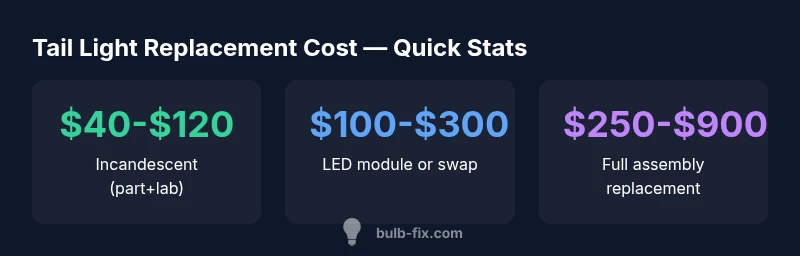
| Incandescent tail bulb (replace only) | 5-15 | 0.5-1.0 hours | 40-120 |
| LED tail light module (replacement bulb) | 20-60 | 1-2 hours | 100-300 |
| LED tail light assembly (full housing) | 100-600 | 1-3 hours | 250-900 |
Got Questions?
What factors drive tail light replacement costs the most?
The biggest drivers are bulb type (incandescent vs LED/module), how accessible the tail light is, and whether you replace just the bulb or the entire assembly. Vehicle design and labor rates in your area also play substantial roles.
The main cost drivers are bulb type, access, and whether you replace just the bulb or the whole assembly.
Can I replace tail light bulbs myself?
Yes, for many incandescent bulbs you can swap the bulb yourself with basic hand tools. LED modules or full assemblies are more complex and may require professional service to ensure proper sealing and alignment.
Yes, you can, especially for basic bulbs, but LED modules often need a pro.
Are LED tail lights more expensive to replace than incandescent ones?
Yes. LED modules and assemblies typically cost more due to advanced components and stricter sealing requirements, and labor time tends to be longer because of calibration needs.
LED replacements usually cost more, both parts and labor.
Is it cheaper to replace the entire tail light assembly?
Not usually. Whole assemblies cost more upfront, but they simplify installation and guarantee compatibility and sealing. Individual bulb replacements are cheaper if the bulbs themselves fail.
Usually not cheaper upfront, but it can be simpler and safer.
How long does tail light bulb replacement take?
DIY bulb swaps can take 15–60 minutes depending on access. Professional replacements, especially for LED modules, may take 1–2 hours or more including testing.
It varies: quick for bulbs, longer for LED modules.
Do dealerships always require replacement by dealer parts?
Not always. Independent shops can source OEM or aftermarket parts. In some cases, dealer parts are recommended for exact fit or warranty reasons, but many repairs can be done by reputable mechanics.
Not always; shops can often use aftermarket or OEM parts.
“Tail light costs reflect both technology and accessibility. DIY replacements save money, but for LED modules, replacement by a pro is often necessary to ensure proper sealing and function.”
Key Points
- Ask for a line-item estimate to avoid hidden fees
- DIY bulbs save labor, but LED modules often require pros
- LED and full-assembly repairs cost more than incandescent bulbs
- Accessibility determines labor time and price
- Expect higher costs for newer vehicle models