B10 Bulb vs B11: A Comprehensive Comparison
A detailed, objective comparison of B10 vs B11 bulbs, covering shape, base compatibility, light output, dimming, and ideal fixtures to help homeowners select the right bulb.


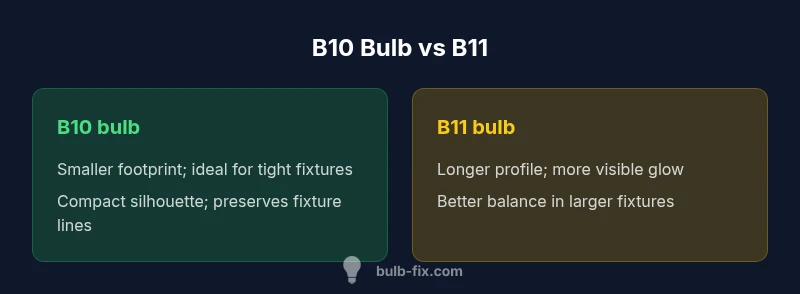
The quick answer to the b10 bulb vs b11 comparison centers on shape, fit, and aesthetic impact. B10 bulbs are smaller and ideal for tight fixtures, while B11 bulbs have a longer silhouette for more prominent decor. Always verify fixture clearance, base type, and dimming compatibility before buying; the right choice depends on your chandelier or sconce design.
Understanding the b10 bulb vs b11
Two common bulb families appear in decorative lighting: the b10 and the b11. They are named for their bulb shape and approximate length—shorter and rounder for the B10, and slightly longer for the B11. Across markets, these designations help homeowners and DIY enthusiasts quickly assess how a bulb will look in a fixture and whether it will physically fit. According to Bulb Fix, the decision between a B10 and a B11 often hinges on fixture design, socket type compatibility, and the available clearance around shades or hardware. The aesthetic impact is real: the B10 offers a compact, discreet glow that keeps silhouettes slim, while the B11 creates a more pronounced glow with a longer presence in the socket. This matters in chandeliers, wall sconces, and vanity lighting where the bulb can be visible or partially concealed.
Beyond aesthetics, understanding these bulbs helps prevent common issues like fitting errors, shade interference, or dimming incompatibilities. Homeowners who plan a swap should carry a tape measure, compare the current bulb length to a known B10 and B11 sample, and note any shade depth or crystal adjuncts that could constrain a longer bulb. The goal is to achieve the intended look without compromising safety, heat buildup, or fixture performance. In many homes, the choice comes down to whether the fixture’s profile benefits from a compact bulb or a more extended silhouette for visual balance and light dispersion.
As you read on, you’ll see that the practical decision hinges less on abstract theory and more on measurable factors like clearance, base compatibility, and how the fixture's shade interacts with the bulb’s shape.
wordCount):null}],
comparisonTable
prosCons
verdictBox
keyTakeaways
faqSection
mainTopicQuery
Comparison
| Feature | B10 bulb | B11 bulb |
|---|---|---|
| Shape and size | Smaller footprint; compact silhouette | Longer profile; more elongated look |
| Base compatibility | Typically uses a standard candelabra base; verify fixture | Typically uses a standard candelabra base; verify fixture |
| Light output (relative) | Varies by wattage/LED option; generally similar after lumen adjustment | Varies by wattage/LED option; generally similar after lumen adjustment |
| Dimming compatibility | Usually compatible with standard dimmers when rated correctly | Usually compatible with standard dimmers when rated correctly |
| Availability & cost | Widely available in many regions; price varies by wattage and tech | Widely available in many regions; price varies by wattage and tech |
Upsides
- Helps achieve desired fixture aesthetics
- Common base types simplify replacement
- Wide availability across retailers
- Flexible use in chandeliers, sconces, and vintage fixtures
- LED options improve energy efficiency and lifespan
Drawbacks
- Shape differences can affect fit in tight spaces
- Dimming behavior may vary with different dimmers
- Not all wattage options are available for every region
- Alternative bases or adapters may be needed for some fixtures
B10 is best for compact spaces; B11 suits larger fixtures and a taller silhouette
Choose B10 when clearance is tight and a discreet look is desired. Choose B11 when the fixture design benefits from a longer bulb profile and more pronounced presence. In both cases, verify base compatibility and dimming support to ensure optimal performance.
Got Questions?
What is the difference between a B10 bulb and a B11 bulb?
The primary difference is silhouette: B10 is smaller and more compact, while B11 is longer and more elongated. Both can share similar bases in many regions, but the fit in your fixture, shade, and dimmer compatibility should drive the final choice.
B10 is the smaller option and fits tight spaces; B11 is the longer option for bigger fixtures. Always check base and dimmer compatibility.
Which bulb is better for chandeliers?
Chandeliers with tight spaces or minimal clearance generally benefit from a B10 bulb due to its compact size. If the chandelier has a larger shade opening or needs a more dramatic silhouette, a B11 may be preferable.
For small chandeliers, go with B10; for larger fixtures, consider B11.
Are B10 and B11 interchangeable?
They can be interchangeable if they share the same base type, wattage rating, and dimming compatibility. It’s essential to verify socket size and any fixture manufacturer recommendations before swapping.
If the base and wattage match, you can swap; otherwise, don’t risk safety or performance.
Do B10/B11 come in LED options?
Yes, both B10 and B11 shapes are available in LED variants, offering energy efficiency and longer lifespans. When choosing LED, also consider color temperature and dimming compatibility with your dimmer.
LED versions exist for both shapes; pick based on energy goals and dimmer compatibility.
What should I check before buying?
Check the bulb shape against fixture space, confirm the base type, verify the maximum wattage the fixture can handle, and ensure your dimmer is compatible with the bulb type you select.
Measure space, check base, wattage, and dimmer compatibility before buying.
Key Points
- Check fixture clearance before choosing
- Verify base compatibility and dimmer support
- Consider bulb silhouette for fixture aesthetics
- Match wattage and color temperature to room mood
- If in doubt, test with samples or photos before buying