CFL Bulb vs Incandescent: An Analytical Comparison
A practical, analytical comparison of CFL bulbs versus incandescent bulbs—covering energy use, lifespan, disposal, cost of ownership, and guidance for choosing the right bulb for home lighting.


Short answer: CFL bulbs (compact fluorescent lamps) use far less energy and last longer than incandescent bulbs, but incandescent bulbs offer warmer light and immediate full brightness. In practice, CFLs save energy and reduce replacements, while incandescent bulbs remain ideal for mood lighting and quick, traditional dimming needs in many homes.
Understanding cfl bulb vs incandescent: what the main differences are
When homeowners start comparing the two most common bulb types, the phrase cfl bulb vs incandescent appears repeatedly in practical guides. At a high level, CFL bulbs are designed to convert electricity into light more efficiently, while incandescent bulbs rely on a heated filament. The energy footprint and maintenance profile are the core levers driving long-term cost and convenience. The Bulb Fix team often sees households misjudge the upfront savings because they overlook replacement frequency and energy consumption over time. In real-world scenarios, the energy savings from CFLs accumulate quickly in rooms that are lit for multiple hours each day, which is precisely why this comparison is essential for anyone planning a home lighting upgrade. The goal here is not to promote one over the other in every situation, but to equip homeowners to choose based on use, fixture compatibility, and lighting preferences. The general takeaway is that cfl bulb vs incandescent choice hinges on energy-conscious use, lifetime expectations, and how much value you assign to warm color and instant brightness. As you review the sections below, you’ll see how these factors play out in common home environments, from kitchens and living rooms to garages and outdoor fixtures. According to Bulb Fix, CFLs typically deliver meaningful energy savings while incandescent bulbs offer familiar warmth and simple compatibility with old fixtures.
How they work and what that means for light output
A fundamental part of the cfl bulb vs incandescent decision is understanding how each bulb creates light. CFLs use a gas-filled tube with a phosphor coating that glows when excited by electricity. The process is efficient, but it requires an electrical ballast to regulate current, and warm-up can be longer than incandescent. Incandescent bulbs produce light when a metal filament heats up to glow, delivering instant brightness and a warm glow that many people associate with traditional rooms. This basic difference translates into several practical outcomes: CFLs generally provide more efficient energy use, while incandescent lighting is often perceived as more flattering for skin tones and ambiance. Homeowners who prioritize energy savings should consider CFLs for rooms that are on for extended periods, while spaces that benefit from a constant warm glow may still favor incandescent bulbs. Practicality, fixture compatibility, and user preference all shape the cfl bulb vs incandescent choice.
Energy efficiency and operating costs (qualitative)
In the wider landscape of home lighting, energy efficiency is a dominant factor in long-term costs. CFL bulbs are designed to deliver noticeably lower energy consumption compared with incandescent bulbs, which translates to lower electricity bills for routinely lit spaces. While the exact savings depend on usage patterns and local electricity rates, the qualitative takeaway is clear: CFLs generally require less energy to produce the same amount of visible light. For homeowners seeking annual savings, CFLs can be a prudent choice in kitchens, living rooms, and hallways where lighting is used for significant portions of the day. Incandescent bulbs, by contrast, consume more energy for the same light output, contributing to higher operating costs if used extensively. Regardless of the choice, the decision should weigh usage patterns, fixture types, and building energy habits to determine the most economical option over time. Bulb Fix analyses consistently highlight energy efficiency as a principal driver for CFL adoption in typical homes.
Lifespan, durability, and maintenance needs
A critical dimension of the cfl bulb vs incandescent debate is lifespan and maintenance. CFL bulbs typically last longer than incandescent equivalents, reducing the frequency of replacement and associated maintenance efforts—an important consideration for ceiling fixtures, enclosed luminaires, or hard-to-reach lamps. Durability can vary by model and usage pattern, but CFLs generally hold up well under normal household conditions. Incandescent bulbs tend to burn out faster, which means more frequent replacements in high-demand rooms. The maintenance advantage of CFLs can be substantial for households that want to reduce the effort and cost of frequent bulb changes. At the same time, the longer warm-up and potential sensitivity to frequent on/off cycles in some CFL designs can influence performance in rooms where lights are turned on and off frequently. When weighing cfl bulb vs incandescent lifespans, consider how often you’ll switch lights on and off in a given space and whether you have convenient access to replacements.
Environmental and health considerations
CFL bulbs introduce a new set of environmental and disposal considerations that homeowners should understand in the cfl bulb vs incandescent conversation. CFLs contain trace amounts of mercury, which means proper handling and recycling are important. This contrasts with incandescent bulbs, which generally do not carry the same mercury disposal requirements. The environmental impact of longer bulb lifespans must be weighed against the mercury concern. If you choose CFLs, check local recycling options, bulk disposal programs, or retail take-back schemes to ensure safe handling. LED lighting is often discussed as a longer-term alternative, but in the CFL vs incandescent framework, mercury content remains a key factor for CFLs. The Bulb Fix team emphasizes responsible disposal to minimize environmental risk while maximizing energy savings over the bulb’s life.
Performance in different settings: dimming, cold weather, and light quality
The performance of CFLs vs incandescent bulbs varies with setting and use. Dimming capability depends on the bulb and the compatible dimmer hardware; some CFL models are fully dimmable, while others require specific dimming solutions to avoid flicker or reduced brightness. Incandescent bulbs typically provide smooth, immediate dimming across a wide range. In cold environments, CFLs may take longer to reach full brightness or exhibit slower response time than incandescent bulbs, which respond instantly. For color quality, incandescent light is often praised for its warm, flattering glow, while CFLs can display a broader color range depending on the phosphor mix and manufacturer. Energy, compatibility, and user experience intersect here to define where cfl bulb vs incandescent remains practical in real homes.
Cost of ownership: upfront vs long-term considerations
From a homeowner’s perspective, upfront cost is a common starting point in the cfl bulb vs incandescent decision, but long-term ownership costs frequently tell a different story. CFL bulbs generally have a higher upfront price than incandescent bulbs, but their energy efficiency and longer lifespan can reduce total costs over time. If you use lights heavily or leave them on for extended periods, CFLs tend to deliver greater value by lowering electricity consumption and reducing bulb replacements. Incandescent bulbs offer low upfront costs and universal compatibility with existing fixtures but can incur higher lifetime costs due to more frequent replacements and higher energy use. The best approach is to model typical usage for each room and compare anticipated replacement frequency and energy bill impact to determine which bulb type offers the best overall value for your home. Bulb Fix’s practical guidance emphasizes considering usage patterns alongside upfront price.
Comparison
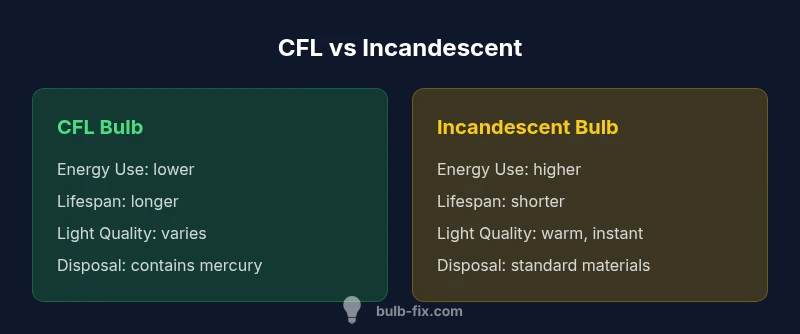
| Feature | CFL bulb | Incandescent bulb |
|---|---|---|
| Energy Use | lower energy use | higher energy use |
| Lifespan | longer lifespan | shorter lifespan |
| Light Quality | cooler/whiter light (phosphor-based) | warmer, amber-hued light |
| Dimming Compatibility | often requires compatible dimmers; some models are dimmable | typically compatible with standard dimmers |
| Upfront Cost | higher upfront cost | lower upfront cost |
| Disposal/Environmental | contains mercury; needs recycling | no mercury; standard disposal |
Upsides
- Lower operating costs over time due to energy savings
- Longer bulb life reduces replacement frequency
- Better for rooms used frequently or for long periods
- Improved energy efficiency with wide availability
Drawbacks
- Contains mercury; disposal requires recycling
- Light quality and dimming performance can vary
- Higher upfront cost in many cases
- Color rendering can feel cooler in some CFLs
CFL bulbs offer the best balance of energy savings and lifespan for most homes, though incandescent bulbs still shine for warmth and instant brightness.
For higher energy savings and fewer replacements, CFLs are usually the better pick. If you prioritize warm, natural light and immediate full brightness, incandescent remains appealing—use selectively and where dimming and color warmth matter most.
Got Questions?
Are CFL bulbs more energy-efficient than incandescent bulbs?
Yes. CFL bulbs use significantly less energy to produce the same light output and typically last longer than incandescent bulbs. This translates to lower operating costs over time, especially in rooms that stay lit for long periods.
Yes. CFLs use less energy and last longer, reducing energy bills and bulb replacements in most rooms.
Do CFLs contain mercury?
Yes. CFLs contain a small amount of mercury. Always recycle them through local programs or retailer take-back schemes to prevent environmental contamination.
Yes, CFLs contain a small amount of mercury. Recycle them properly.
Can CFL bulbs be used with dimmers?
Some CFLs are designed to be dimmable, but you must use a compatible dimmer. Otherwise, CFLs may flicker or fail to reach full brightness.
Some CFLs are dimmable; check the packaging and pair with a compatible dimmer.
Which bulb type has better color rendering?
Incandescent bulbs typically render colors warmly and accurately. CFLs have improved color rendering, but performance varies by model and phosphor composition.
Incandescents usually render color warmly; CFLs are good, but vary by model.
What about disposal and recycling for CFLs?
Because CFLs contain mercury, recycle them through local programs or store take-back events. Do not dispose of them with regular household trash.
Recycle CFLs; don’t throw them with regular trash due to mercury.
Key Points
- Assess room usage to decide CFLs or incandescents
- CFLs save energy but require mindful disposal
- Incandescents provide warm light and instant brightness
- Dimming and fixture compatibility matter for CFLs
- Consider a mixed approach: CFLs for main living areas, incandescent for accents