Fluorescent Bulbs vs Incandescent: A Practical Comparison
A practical Bulb Fix guide comparing fluorescent bulbs and incandescent bulbs on energy use, light quality, lifespan, cost, and disposal to help homeowners decide.


Fluorescent bulb vs incandescent is a classic bulb choice dilemma for homes and small businesses. Both types offer distinct advantages and trade-offs in energy use, light quality, and maintenance. This comparison from Bulb Fix highlights where each shines and where to avoid them, helping you make an informed decision quickly.
Fluorescent bulb vs incandescent: What they are and why it matters
According to Bulb Fix, choosing between a fluorescent bulb vs incandescent often comes down to energy costs, light quality, and maintenance needs. Fluorescent bulbs rely on gas discharge to create light, while incandescent bulbs generate light by heating a filament. In many homes, the right choice depends on how you use the space (task lighting vs. ambient lighting), your fixtures, and whether you value efficiency over warm light. Understanding these core differences helps homeowners make practical decisions, whether upgrading an old fixture or selecting bulbs for a new room.
In practice, the decision isn’t only about efficiency; it also touches color, reliability, and disposal responsibilities. Bulb Fix’s guidance emphasizes evaluating room function, the expected burn-in period, and the fixture’s compatibility with different bulb technologies. This section will unpack the contrasts between a fluorescent bulb vs incandescent options so you can map them to real-world use cases.
Energy Efficiency and Operating Costs: The big picture in fluorescent bulb vs incandescent_choice
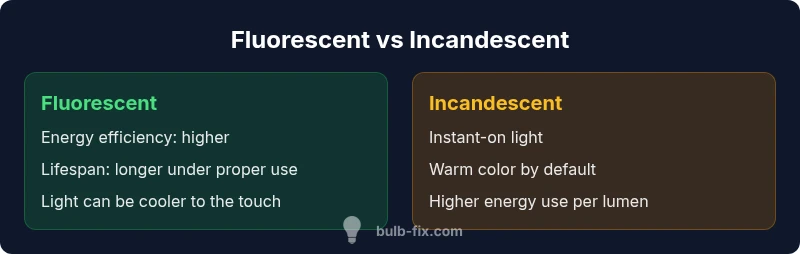
When comparing energy efficiency, the fluorescent bulb vs incandescent debate typically points to lumen-per-watt performance. Fluorescent options generally convert more electricity into visible light for the same amount of energy, which translates to lower operating costs in many settings. However, efficiency is not the only factor; effective light output is influenced by color temperature, fixture design, and the ambient environment. For the homeowner, the key takeaway is to calculate how many hours you’ll use the light and what you’re paying per lumen, then weigh that against bulb price and replacement frequency. Bulb Fix highlights that in steady-use areas like kitchens or garages, fluorescent bulbs often deliver meaningful energy savings over time, though this depends on the exact product family and fixture compatibility.
In contrast, incandescent bulbs generally consume more energy per lumen. This traditional technology remains attractive in spaces where warmth and instant-on performance are paramount, and where fixtures are not compatible with more modern bulb types. The energy cost gap tends to be larger in long-running spaces than in short, decorative uses. The practical approach is to estimate your annual lighting hours and compare total cost of ownership, not just upfront price.
Comparison
| Feature | Fluorescent bulb | Incandescent bulb |
|---|---|---|
| Energy efficiency | Higher efficiency per lumen (varies by tube/compact type) | Lower efficiency per lumen |
| Lifespan | Typically longer lifespan in appropriate fixtures | Typically shorter lifespan |
| Startup time | Longer warm-up or slower strike (dependent on ballast type) | Instant-on capability |
| Color rendering (CRI) | CRI varies by phosphor mix; modern fluorescents can approach good CRI | Very high CRI near incandescent for some bulbs; generally excellent for warm light |
| Dimming compatibility | Dimming possible but requires compatible ballast/dimmer | Widely compatible with traditional dimmers |
| Heat output | Lower heat output during operation | Higher heat output |
| Initial cost | Often higher upfront than incandescent (depends on type) | Lower upfront cost |
| Disposal | Contains mercury; requires proper recycling | No hazardous materials; simple disposal |
Upsides
- Energy efficiency advantages in the right fixtures
- Longer replacement intervals reduce maintenance
- Lower heat output improves comfort and safety
- Good color options with modern fluorescent products
Drawbacks
- Mercury content requires careful disposal and recycling
- Dimming and startup performance can be variable
- Fluorescent performance can decline in very cold environments
- Incandescent bulbs are less energy-efficient and waste more energy
Fluorescent bulbs are generally the better choice for energy efficiency and long-term costs, while incandescent bulbs excel in warm, instant light and simple compatibility.
If you prioritize efficiency and fewer replacements, fluorescent is typically the better option. Choose incandescent when you want immediate warmth, simple operation, and broad fixture compatibility. In some spaces, a mixed approach or considering LEDs as a modern alternative may offer the best balance.
Got Questions?
Which bulb lasts longer, fluorescent or incandescent?
In general, fluorescent bulbs offer longer lifespans in typical use, reducing replacement frequency. Incandescent bulbs burn out faster under standard use conditions. Actual results depend on the specific product type, operating environment, and fixture quality.
Fluorescent bulbs typically last longer than incandescent bulbs in normal use, reducing how often you need to change them.
Can I replace incandescent with fluorescent in any fixture?
You can replace incandescent bulbs with fluorescent types in many fixtures, but you must ensure ballast compatibility and fixture allowance. Some fixtures are designed for incandescent-only operation and may require rewiring or special sockets.
You can often swap to fluorescent bulbs if the fixture supports it and you have the right ballast. Check the fixture label first.
Are fluorescent bulbs safe for homes with kids and pets?
Fluorescent bulbs themselves are generally safe when used as intended. They do contain small amounts of mercury in some designs, so proper disposal and recycling are important. Keep bulbs intact to avoid breakage and follow local guidelines.
Fluorescent bulbs are safe when used correctly, but recycle them properly because they contain mercury.
Do fluorescent bulbs perform well in cold environments?
Performance in cold temperatures varies by bulb type. Some fluorescent designs struggle in very cold spaces, while others are designed to perform better. Incandescent bulbs typically maintain consistent performance in cold conditions.
Some fluorescents don’t perform as well in the cold, while incandescent bulbs keep working reliably.
Should I consider LED as an alternative to fluorescent or incandescent?
LEDs offer high energy efficiency, long lifespans, and versatile color options. They often outperform both fluorescent and incandescent in long-term energy use and maintenance, making them a popular modern choice.
LEDs are a great middle ground with high efficiency and long life; they’re worth considering as a modern option.
Key Points
- Prioritize energy savings for high-usage rooms
- Opt for incandescent when warmth and instant light matter
- Plan for proper disposal of fluorescent bulbs
- Check fixture compatibility before swapping types
- Consider LEDs as a modern middle ground