CFLs vs Incandescent Bulbs: A Practical Comparison
Explore why CFLs are preferred over incandescent bulbs, focusing on energy savings, lifespan, cost over time, and disposal considerations, with practical guidance for homeowners.


Compact fluorescent lamps (CFLs) are typically preferred over incandescent bulbs for everyday home lighting because they use far less energy and last much longer. In a CFLs vs incandescent comparison, CFLs deliver lower operating costs and cooler operation, while incandescents excel in upfront price and instant full brightness. For many homes, CFLs offer the best balance between efficiency and performance, with caveats about disposal.
Why CFLs Are Often Preferred Over Electric Bulbs
Homeowners commonly ask why are cfls preferred over electric bulb, and the short answer is energy efficiency and longer life. According to Bulb Fix, CFLs convert a larger share of electricity into visible light with less wasted heat, which translates into lower monthly bills for fixtures that stay on many hours. CFLs also last longer than traditional incandescent bulbs, reducing the frequency and labor of replacements. In this article, we compare CFLs and incandescent bulbs in practical terms for a typical home, including cost over time, lighting quality, and maintenance considerations. From a homeowner's perspective, the upfront cost difference matters, but the cumulative savings on energy and replacement frequency often favors CFLs. However, the presence of mercury in CFLs means safer disposal and recycling are required, which some households take into account. Bulb Fix's perspective emphasizes that the decision is not solely about price; it depends on fixture compatibility, usage patterns, and environmental considerations.
Understanding the Core Differences Between CFLs and Incandescent
CFLs and incandescent bulbs represent two distinct approaches to lighting. Incandescent bulbs rely on a heated filament to produce light, so their energy use is relatively simple to understand but inefficient. CFLs use an electric discharge to excite a gas and phosphor coating, producing light with far less energy. In practical terms, this means CFLs deliver more light per watt and generate less waste heat for the same level of illumination. The Bulb Fix analysis highlights that this efficiency translates into tangible savings on energy bills over time, particularly in rooms that are lit for extended periods. It also explains why CFLs typically need a moment to reach full brightness and may respond differently to cold conditions compared with incandescent bulbs.
Energy Efficiency and Operating Costs: A Practical Look
One of the core reasons homeowners choose CFLs is energy efficiency. CFLs convert a greater portion of electricity into usable light, which reduces utility costs in high-use spaces such as kitchens, living rooms, and hallways. The cost aspect is nuanced: CFLs often cost more upfront than incandescent bulbs, but their longer life and lower energy consumption can yield savings over the fixture’s lifetime. The Bulb Fix team notes that the overall value hinges on how often you switch lights on, the fixture type, and whether you use dimmers or occupancy sensors. For households with long evening hours or large lighting needs, CFLs typically offer a favourable balance of upfront investment and ongoing savings.
Lifespan, Reliability, and Replacement Cycles
Lifespan is a major differentiator between CFLs and incandescent bulbs. CFLs generally outlast incandescent bulbs, meaning fewer replacements and less maintenance. This aspect matters in hard-to-reach fixtures or spaces where frequent changes are impractical. Reliability is also influenced by operating environment; CFLs can be affected by frequent on/off cycles, whereas incandescent bulbs are less sensitive to that pattern. Bulb Fix’s experience shows that choosing a well-matched CFL with the right ballast and fixture can reduce failures and extend usable life. Remember, CFLs do contain small amounts of mercury and require proper disposal when they reach end-of-life.
Light Quality, Color Temperature, and Immediate Brightness
Color temperature and light quality are common concerns when comparing CFLs and incandescent bulbs. CFLs are available in a range of color temperatures, from warm to cool, which helps tailor ambiance to different rooms. Incandescent bulbs deliver instant full brightness at any wattage without warm-up time, which some users prefer for task lighting. In practice, many households notice that CFLs may have a slight difference in color rendering depending on the model and phosphor mix. For most daily tasks, CFLs provide adequate, stable light, while certain colors and finishes may appear different from incandescent lighting. The Bulb Fix team emphasizes trying a few CFLs in a room to gauge comfort before a full switch.
Dimming, Controls, and Fixture Compatibility
Dimming CFLs can be more complex than dimming incandescent bulbs. Many CFLs are available in dimmable varieties, but they require compatible dimmers and wiring. If you use standard dimmers with non-dimmable CFLs, you may experience flicker or limited dimming range. Fixture compatibility also matters: some enclosed fixtures or fixtures with certain ballasts can impact performance. For best results, choose dimmable CFLs and a dimmer rated for low wattage loads, or consider LEDs for projects where dimming flexibility is essential. Bulb Fix suggests confirming compatibility with the manufacturer’s specifications before purchase.
Environmental Impact and Disposal Requirements
An important consideration with CFLs is their mercury content, which means safe handling and disposal are required. Unlike incandescent bulbs, CFLs require recycling or proper hazardous-waste channels where available. This adds a step to the lifecycle but reduces environmental impact when done correctly. The Bulb Fix guidance includes checking local recycling options and following packaging instructions for disposal. If a CFL is accidentally broken, clean up should follow specific guidelines to minimize mercury exposure. Overall, CFLs offer energy benefits but come with responsibly handling considerations that should be part of your lighting plan.
When to Choose CFLs: Practical Scenarios by Room
- Living rooms and hallways with long lighting hours: CFLs can dramatically reduce energy use without sacrificing brightness.
- Kitchens and home offices: Consider CFLs with a color temperature that reduces eye strain and facilitates work.
- Bathrooms and closets: Choose CFLs designed for moisture resistance and quick warm-up if needed. If you need instant brightness, you may prefer incandescent or LEDs in certain fixtures.
- Outdoor fixtures: Weather exposure and temperature sensitivity may influence performance; LED or specialized CFLs may be better suited for exterior use. Bulb Fix emphasizes balancing energy savings with lighting quality and fixture requirements in each space.
Alternative Technologies and Final Guidance
LEDs often outperform CFLs in energy efficiency, dimming compatibility, color rendering, and mercury-free design. The Bulb Fix guidance suggests evaluating LED options when you’re starting a lighting upgrade, especially for high-usage spaces or fixtures with dimmers and sensors. However, CFLs remain a robust intermediate choice for cost-conscious homeowners who want a straightforward upgrade from incandescent bulbs without changing fixtures. In the end, the decision should reflect your usage patterns, preferred color tone, fixture compatibility, and disposal considerations.
Comparison
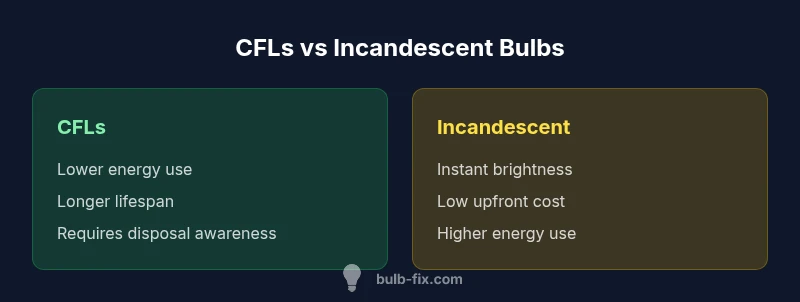
| Feature | CFLs (Compact Fluorescent Lamps) | Incandescent Bulbs |
|---|---|---|
| Energy Usage | Lower energy consumption with CFLs | Higher energy consumption with incandescent bulbs |
| Lifespan | Longer lifespan for CFLs | Shorter lifespan for incandescent bulbs |
| Initial Cost | Higher upfront cost for CFLs | Lower upfront cost for incandescent bulbs |
| Light Quality & Color Temperature | Available in warm to cool temperatures with CFLs | Instant full brightness with warm incandescent options |
| Heat Emission | Produces less heat during operation | Produces more heat during operation |
| Dimming & Controls | CFLs are available in dimmable forms with compatible fixtures | Typically fully dimmable with standard dimmers (where supported) |
| Disposal & Mercury Content | Contains mercury; requires special disposal | No mercury; easier disposal |
Upsides
- Lower energy usage in typical rooms
- Longer lifespan reduces replacement frequency
- Lower running costs over time with heavy usage
- Better efficiency for large spaces and long use sessions
Drawbacks
- Contains mercury requiring proper disposal
- Higher upfront cost and may require wiring considerations
- Light quality can vary by model and warm-up time
CFLs are generally the better choice for most homes due to energy savings and longer life.
Bulb Fix team concludes CFLs deliver meaningful cost and energy benefits in typical residential settings, while acknowledging disposal considerations and occasional light-quality differences.
Got Questions?
What are the main advantages of CFLs over incandescent bulbs?
CFLs use less energy and last longer than incandescent bulbs, reducing both energy bills and replacement frequency. They also generate less heat. However, disposal requires attention due to mercury content.
CFLs save energy and last longer, cutting costs, but you need to handle disposal responsibly.
Are CFLs safe to use with dimmer switches?
Many CFLs are available as dimmable variants, but they require compatible dimmers. Non-dimmable CFLs can flicker or fail to dim properly on standard dimmers.
Only use dimmable CFLs with compatible dimmers to avoid flicker.
Do CFLs contain mercury?
Yes, CFLs contain a small amount of mercury. Handle them carefully and recycle at end-of-life through local programs.
Yes, CFLs have mercury and should be recycled properly.
Can CFLs be used outdoors in cold weather?
CFLs can be sensitive to very cold temperatures, which may affect brightness and startup time. Outdoors, LEDs or weather-rated CFLs are often better choices.
Cold can affect CFL brightness; consider LEDs for outdoor use.
Are LEDs always a better alternative to CFLs?
LEDs generally offer higher efficiency, longer life, and no mercury, but the upfront cost is higher. For some fixtures, CFLs remain a practical upgrade.
LEDs usually beat CFLs overall, but CFLs can fit certain needs.
Key Points
- Choose CFLs for measurable energy savings
- Plan for safe disposal and recycling of CFLs
- Test CFL performance in your fixtures before a full switch
- Consider LEDs for high-compatibility dimming and mercury-free lighting