Why CFL Is a Better Alternative to Bulbs for Homes
Discover why CFL is a better alternative to standard bulbs for home lighting, covering energy efficiency, lifespan, cost considerations, and safe disposal, with insights from Bulb Fix.


CFLs offer a practical energy-saving alternative to incandescent bulbs, delivering lower running costs and a longer lifespan in many home settings. They also raise considerations around disposal due to mercury content, which Bulb Fix highlights as an important factor. The quick answer is that CFLs are a solid middle ground between upfront cost and long-term savings, though LEDs remain the most efficient option. See the full comparison below to understand when CFLs fit best in your home lighting plan.
Why CFL Is a Practical Alternative in Modern Homes
When homeowners begin evaluating their lighting options, they often ask a core question: why is cfl a better alternative as compared to bulb? In practical terms, CFLs deliver much lower energy use per lumen than traditional incandescent bulbs, which translates into lower monthly bills and less heat in rooms that run lights for long periods. According to Bulb Fix, CFLs provide meaningful energy savings for kitchens, hallways, and work spaces, while maintaining familiar brightness. The Bulb Fix team found that in typical family homes, CFLs offer a good blend of efficiency and reliability for everyday tasks, without requiring specialized fixtures. This section sets the stage for a deeper comparison by outlining where CFLs shine and where incandescent bulbs still hold advantages. Throughout this guide, you’ll see how the tradeoffs break down in real-world settings: longevity in frequent-use rooms, compatibility with common fixtures, and practical considerations around disposal and replacement. The goal is not to declare a universal winner, but to arm homeowners with a clear framework for choosing between CFLs and traditional bulbs in a way that matches usage patterns, budgets, and comfort levels. Readers should keep in mind that the question why is cfl a better alternative as compared to bulb is situational, and the answer depends on where and how you light your home. The Bulb Fix team recommends evaluating rooms by activity, not just by wattage, to decide whether CFLs fit the bill.
Key Differences Between CFL and Incandescent Bulbs
The two most common lightbulb families—CFLs and incandescent bulbs—share the same purpose but are built on different principles, which drives how they perform in a home setting. Energy efficiency is the primary differentiator: CFLs produce similar light levels with far less electricity than incandescent bulbs, making them substantially cheaper to operate over the life of a bulb. Another difference is heat generation: incandescent bulbs convert a larger share of electrical energy into heat, which can raise room temperatures in warm climates or small spaces. In terms of lifespan, CFLs generally last longer; however, real-world durability depends on fixture quality, vibration, and usage patterns. Color quality and perceived warmth matter too: CFLs have evolved from early models that appealed less aesthetically than incandescent bulbs, and modern CFLs offer a variety of color temperatures to suit living rooms, kitchens, and home offices. Dimming capability is another area where both families differ: older CFLs may not dim smoothly with standard dimmers, while incandescent bulbs behave predictably; newer dimmable CFLs require compatible dimmers. Finally, consider disposal: CFLs contain a small amount of mercury and require recycling or safe disposal, whereas incandescent bulbs do not. A clear, balanced view of these differences helps homeowners align choices with needs and tolerances for energy use, cost, and simplicity.
Energy Efficiency at a Glance: CFL vs Incandescent
Comparison of energy efficiency should focus on brightness per watt rather than raw wattage alone. When measuring the common homeowner use case—providing roughly the same light output—CFL bulbs typically deliver the required brightness with far less energy. In practice, this means a CFL used in a 60-watt incandescent equivalent can require significantly less power to achieve the same lumen output. The result is lower electricity use across daily routines like cooking, cleaning, and evening reading. For households aiming to reduce energy footprints, CFLs often become the default choice in rooms used intensively, such as kitchens, home offices, and hallways. It’s important to recognize that LED bulbs outperform CFLs on energy efficiency, but CFLs offer a more affordable step up from incandescent in many markets. The decision should hinge on usage patterns, fixture compatibility, and the desire for a gradual transition rather than a single silver bullet. In sum, the core question why is cfl a better alternative as compared to bulb centers on energy efficiency, with CFLs delivering meaningful savings in typical home lighting scenarios.
Lifespan and Durability: Will CFL Last?
Lifespan is a major factor for homeowners, because frequent replacement increases both cost and downtime. CFLs generally outlast traditional incandescent bulbs in typical home use, especially in fixtures where lights are left on for long portions of the day. The slower warm-up time of CFLs is a trade-off; you’ll enjoy energy savings and cooler operation, but you may experience delayed brightness when turning on a light in a cold room. Durability depends on the fixture and installation: CFLs with robust housings and proper vibration resistance perform well in ceiling fixtures and wall sconces, while rough service lamps can shorten life. If you frequently switch lights on and off, incandescent bulbs can seem more responsive, but CFLs still provide sustained efficiency. When assessing the choice, consider the total cost of ownership, including energy savings and the longer operational life CFLs offer in many residential contexts. A practical approach is to group rooms by usage—high-traffic areas versus occasional-use rooms—to optimize where CFLs make the most sense.
Color Quality, Light Comfort, and Dimmability
Color rendering and warmth influence how comfortable a room feels. Early CFLs sometimes produced cooler tones and flicker, but modern CFLs come in a range of color temperatures—from warm ambers to cool daylight—that can mimic incandescent warmth or provide crisp task lighting. Dimming is another consideration: many CFLs require compatible dimmers and may not ramp brightness smoothly with older dimming controls; if dimming is a priority, verify product specs and fixture compatibility. For rooms where color accuracy is important—like kitchens, living rooms with artwork, or home offices—choose CFLs labeled with a high color rendering index (CRI) and a color temperature that matches the desired mood. The goal is to avoid harsh shadows and color distortion, while preserving energy savings. If you rely on soft, cozy lighting, you might lean toward warmer CFLs or even consider LEDs for high fidelity color while maintaining energy goals.
Cost of Ownership: Upfront vs Running Costs
Upfront cost is a common consideration when evaluating CFLs against incandescent bulbs. CFLs typically cost a bit more per bulb at purchase, but the energy savings over time often offset this difference. Budget-conscious homeowners may also weigh the need for a broad replacement in multiple fixtures; CFLs can require fewer replacements in active spaces where lights run daily. Over the long term, energy savings accumulate, reducing monthly electrical bills and making CFLs a more economical option than incandescent bulbs in many circumstances. It’s also important to plan for disposal costs and green practices: CFLs contain mercury, so they must be recycled responsibly, which can influence the overall environmental cost of ownership. Finally, if your home already has modern LED fixtures, you may achieve better efficiency with LEDs, but CFLs remain a cost-effective step up from incandescent for many households.
Environmental and Disposal Considerations
CFLs contain a small amount of mercury, which means safe handling and recycling are essential. Never throw CFL bulbs in the household trash; instead, use local recycling programs or take them to a household hazardous waste facility. The environmental benefits of CFLs—reduced energy use and lower greenhouse gas emissions from electricity generation—can be most pronounced in energy-intensive homes, but the mercury content adds a responsibility factor that must be managed. The EPA and other authorities provide guidelines for safe disposal; consult your local program to learn about drop-off locations and handling requirements. In practice, simple steps like storing spent CFLs in a sealed container until disposal and verifying recycling options with your waste service can make a big difference. If the home uses multiple CFLs, coordinate with your local recycling site to schedule bulk drop-offs to minimize trips. These practices help balance energy savings with environmental stewardship.
Practical Installation and Compatibility Tips
Before replacing bulbs, check whether fixtures are compatible with CFLs. Incandescent lamps do not require ballast, while CFLs operate with integrated electronic drivers; some older fixtures or dimmers may not work well with CFLs. If you plan to switch in rooms with dimming controls, look for CFLs labeled as dimmable and pair them with a compatible dimmer. In ceiling fixtures, ensure the fixture can accommodate the physical size of the CFL and verify that the lamp base matches the bulb type (E26/E27, etc.). For enclosed fixtures, choose CFLs rated for enclosed use to avoid overheating. Consider color temperature: warm tones create cozy spaces, while higher temperatures provide task lighting for kitchens or home offices. Finally, when replacing an entire household, consider a staged approach: start with areas with the highest daily use, monitor performance, and adjust accordingly. If your goal is to balance energy savings with ease of use, CFLs in suitable fixtures can be a practical solution.
Real-World Scenarios: When CFL Makes Sense
In kitchens and hallways or in spaces with long daily lighting, CFLs can offer comfortable, steady illumination with lower energy draw than incandescent bulbs. For rooms with frequent on/off cycles, such as closets or powder rooms, the longer warm-up time can be less critical, and CFLs still deliver savings. In home offices and living rooms where colors matter, trial CFL options with different color temperatures to find a balance of warmth and brightness. For homes that are predominantly wired for LED fixtures, switching to CFLs might be a transitional step, offering some energy benefits while maintaining familiar light quality. If you are constructing a new home or remodeling, you might choose LEDs for maximum efficiency, but CFLs can fill a niche where LED availability is limited or where initial costs constrain the project budget. The decision ultimately hinges on usage patterns, fixture compatibility, and the home's energy goals.
Comparison
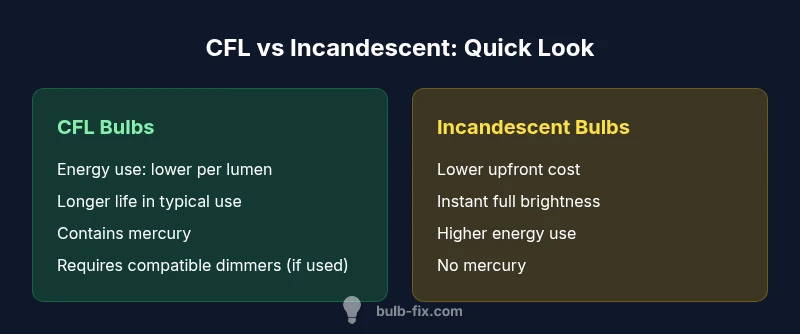
| Feature | CFL bulb | Incandescent bulb |
|---|---|---|
| Energy use per lumen | Lower with CFL | Higher with incandescent |
| Lifespan | Longer with CFL (in many setups) | Shorter with incandescent |
| Initial cost | Moderate upfront cost | Lowest upfront cost |
| Heat emission | Less heat produced | More heat produced |
| Dimming compatibility | Often needs compatible dimmers | Widely compatible with basic dimmers |
| Disposal | Contains mercury; recycle | No hazardous materials; easy disposal |
| Color temperature options | Wide range of CFL temperatures | Limited color options |
| Best for | Energy-conscious homes with long-use rooms | Budget-focused spaces or occasional-use rooms |
Upsides
- Lower energy use than incandescent for the same light output
- Longer operational life in typical home use
- Better cost-to-benefit balance than old fluorescent options
- Wamiliar light quality for many rooms
Drawbacks
- Contains mercury; requires proper disposal and recycling
- Not all CFLs are dimmable with standard dimmers
- Warm-up time is longer than incandescent and faster LEDs
- Availability and performance vary by fixture and model
CFLs strike a practical balance between upfront cost and running savings, making them a solid middle-ground option.
Choose CFLs when you want meaningful energy reductions without paying LED-level prices. They work well in high-use rooms and with compatible fixtures, but LEDs will outperform CFLs on efficiency and long-term durability.
Got Questions?
What are the main advantages of CFL over incandescent?
CFL bulbs use less energy to produce the same amount of light, which lowers electricity bills. They also typically last longer than incandescent bulbs, reducing replacement frequency.
CFLs save energy and last longer than incandescent bulbs, which means fewer replacements and lower bills.
Do CFLs contain mercury?
Yes, CFLs contain a small amount of mercury. Handle them carefully and recycle them through approved programs to avoid environmental release.
Yes, CFLs have a small amount of mercury, so recycle them properly.
Are CFLs compatible with dimmers?
Many CFLs are not compatible with older dimmers. Look for CFLs labeled ‘dimmable’ and ensure your dimmer is CFL-friendly.
Some CFLs can be dimmed, but you need dimmable bulbs and a compatible dimmer.
Are CFLs a good transition to LED lighting?
CFLs can be a practical intermediate step for energy savings before upgrading to LEDs, which offer the highest efficiency.
CFLs are a good bridge to LEDs for energy savings, but LEDs are more efficient in the long run.
How should CFLs be disposed of?
Take them to local recycling or hazardous waste programs that accept CFLs; never toss them in regular trash.
Recycle CFLs at local facilities; don’t put them in the trash.
How do I choose the right CFL color temperature?
Warm temperatures (2700K-3000K) create cozy spaces; cooler temps (3500K-4100K) suit work areas and task lighting.
Pick warm for cozy rooms, cool for task lighting and offices.
Key Points
- CFLs offer meaningful energy savings over incandescent bulbs
- Ensure fixture compatibility, especially for dimming and enclosed fixtures
- Dispose CFLs responsibly due to mercury content
- Consider LEDs for maximum efficiency in new installations