How Often to Change Headlight Bulbs
Discover how often to change headlight bulbs across halogen, LED, and HID systems. Learn lifespans, signs of failure, and safe, DIY replacement tips for homeowners and DIY enthusiasts.


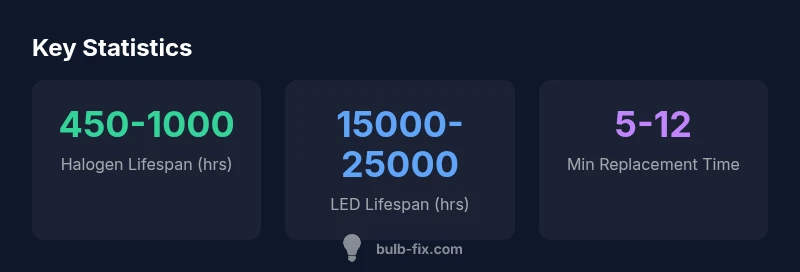
There's no universal replacement interval for headlight bulbs. Halogen bulbs typically last about 450–1,000 hours, which equates to roughly 1–2 years for average driving. LED headlights can last 15,000–25,000 hours or more, often exceeding a decade. In practice, replace when you notice dimming, color change, or failure, and follow your vehicle's guidelines.
Understanding Headlight Bulb Longevity
Bulbs are wear items; their lifespan depends on the type and operating conditions. Halogen bulbs burn through their tungsten filament when turned on for extended periods, and their luminosity degrades over time. LED headlights use solid-state diodes that can last much longer but are sensitive to high temperatures and electrical noise. HID/Xenon bulbs rely on a gas discharge tube and ballast; they can last mid-range but have unique failure modes. Ambient temperature, moisture ingress, road vibrations, and poor electrical connections can shorten any bulb's life. Routine inspections, especially after winter driving or rough roads, help catch dimming early. In practice, the average car uses halogen bulbs for about 450-1,000 hours, while LED might reach tens of thousands of hours; however, many drivers experience earlier failure due to system issues like electrolyte leaks, ballast faults, or power surges. As a homeowner, you should track your driving patterns, check alignment, and maintain clean lens surfaces; these steps help you interpret bulb health more accurately and plan replacements without being caught in unsafe nighttime driving.
Lifespan by Bulb Type: Halogen, LED, HID
Halogen bulbs are the most common and typically the least expensive. They convert electricity into heat, and their tungsten filament gradually loses brightness. Expect roughly 450-1,000 hours; in practical terms, many drivers swap halogens every 1-2 years depending on usage. LED headlights use efficient diodes that produce light with minimal energy loss and can outlive car warranties; typical lifespans are in the range of 15,000-25,000 hours, with some premium LEDs lasting longer in favorable cooling conditions. HID or Xenon bulbs combine gas-discharge technology with a ballast; their lifespan is often around 2,000-3,000 hours but can be longer if the ballast and electrical system stay stable. When evaluating a replacement, consider not only hours but the condition of the light output (brightness and color) and whether the headlamp lens is clean and free of haze, as dimmest bulbs can be masking a broader lighting issue.
Signs It's Time to Change Headlight Bulbs
Dim brightness or color shift: If one bulb looks noticeably dimmer than the other or shows a yellow tarnish, that's a red flag. Flickering or intermittent operation indicates an electrical issue or failing ballast. Physical signs: cracks in the bulb, moisture inside the headlight assembly, or a bulb that cannot reach full brightness after replacement. Use a simple test: operate the headlights after dark against a flat, light-colored surface; if you struggle to see lane markers, plan a replacement soon. Don't ignore headlight failure—driving with poor lighting reduces visibility and increases risk, particularly in rain or fog. Remember that some vehicles require both bulbs to be replaced in pairs to maintain even brightness; check the owner's manual for guidance on pairing bulbs.
Headlight bulb longevity by type
| Bulb Type | Typical Lifespan | Common Causes of Failure | Typical Replacement Time (minutes) |
|---|---|---|---|
| Halogen | 450-1000 hours | Vibration, moisture, poor connections | 5-10 |
| LED | 15000-25000 hours | Thermal issues, power surges | 5-8 |
| HID/Xenon | 2000-3000 hours | Ballast failure, moisture | 7-12 |
| Sealed Beam (older cars) | 1000-2000 hours | Lens haze, moisture | 5-9 |
Got Questions?
Do headlight bulbs need to be replaced in pairs?
In many vehicles, replacing both sides at the same time ensures even brightness. Some models, particularly with LED or HID setups, may require pairing for optimal performance. Always check the owner's manual for model-specific guidance.
Usually replace both at once to keep brightness even; check your manual.
How long does it take to change a headlight bulb?
Most replacements take about 5 to 15 minutes per bulb, depending on access and vehicle design. Some cars require more time if components must be removed to reach the bulb.
Typically 5 to 15 minutes per bulb.
Can I replace a halogen bulb with LED directly?
Usually not without checking compatibility. LED replacements may require a proper ballast, CAN-bus adjustments, or housing compatibility. Always verify with your vehicle manual or a trusted guide.
Often not—check compatibility before swapping.
What should I do if one headlight bulb fails but the other still works?
Diagnose for broader electrical issues and consider replacing both bulbs to maintain even lighting. Ensure the replacement matches the other side in brightness and color.
Check the other side and consider replacing both for even brightness.
Is it dangerous to drive with a burnt-out headlight?
Yes. Driving with a burnt-out headlight is unsafe and illegal in many places. Replace as soon as possible to restore visibility and comply with regulations.
Yes, stop and replace immediately.
How much do replacement bulbs typically cost?
Costs vary by type. Halogen bulbs are among the cheaper options, while LEDs and HID bulbs can be more expensive due to technology and components.
Costs vary by type; expect a wider price range for LEDs/HID.
“Consistent maintenance reduces nighttime risk; choose bulbs that fit your car’s electrical and optical system.”
Key Points
- Check your vehicle manual for bulb type and replacement guidance.
- Inspect headlights at least once a year, or every 12 months.
- Replace bulbs in pairs if two sides show aging to maintain even brightness.
- Avoid touching bulb glass with bare hands to extend life.