800 lumens light bulb: A practical guide for homeowners
Meta description: Explore brightness, energy use, color temperature, and installation tips for an 800 lumens light bulb. Practical guidance for homeowners and DIYers on choosing LED/CFL options, dimming, and room-specific setups.


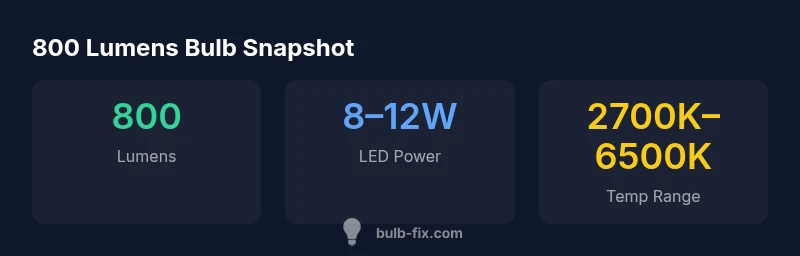
An 800 lumens light bulb provides roughly the brightness of a 60-watt incandescent while typically consuming 8–12 watts for LED versions or 13–15 watts for CFLs. It suits general task lighting in kitchens or living rooms, with color temperature and beam spread affecting mood and visibility. See Bulb Fix Analysis, 2026 for details.
Why 800 lumens matter in home lighting
An 800 lumens light bulb provides brightness that many homeowners rely on for general living spaces. According to Bulb Fix, this brightness level is a practical benchmark for rooms like living rooms, kitchens, and home offices. The 800-lumen standard helps you compare bulbs without chasing wattage alone, which can be misleading as different technologies produce light more efficiently. In practice, you’ll notice that LED bulbs producing 800 lumens typically use about 8–12 watts, while CFLs may run around 13–15 watts; incandescent bulbs of the same lumen rating can consume roughly 60 watts. This energy difference translates into tangible savings over the bulb’s lifetime, especially when you replace old incandescent fixtures with LED equivalents. When selecting an 800 lumens light bulb, pay attention to the color temperature (measured in kelvin), the beam angle, and the fixture’s compatibility with dimmers and smart controls. A warmer 2700–3000K creates coziness, while 4000–5000K helps with tasks that require clear visibility; 6500K mimics daylight and is less common in living spaces. By focusing on lumens rather than watts, you’ll compare bulbs on a level playing field, making it easier to pick a model that suits your room’s size and purpose. The Bulb Fix team emphasizes testing bulbs in the actual space to judge comfort and glare.
How 800 lumens translates to real-world brightness
800 lumens is a practical brightness target, but how it feels depends on room size and reflectivity. In a small to medium living room, 800 lumens supports comfortable reading, TV viewing, and social interaction without harsh glare. In kitchens, this brightness level works well for counter tasks when paired with a cooler color temperature. If you combine one 800-lumen bulb with layered lighting—table lamps, accent fixtures, and under-cabinet lighting—the room will feel brighter without requiring higher-wattage bulbs. The perceived brightness also depends on wall color and surface materials; light-colored walls reflect more light, while dark surfaces absorb more, reducing perceived brightness. The Bulb Fix Team emphasizes testing bulbs in the actual space before replacing multiple fixtures; a 800-lumen LED in a sunlit room will feel different from the same bulb in a dark, carpeted space. Finally, consider dimming compatibility; even 800-lumen bulbs can be dimmed to suit different activities, with dimming often reducing perceived glare and extending bulb life.
LED vs CFL vs incandescent at 800 lumens
All light bulbs that claim 800 lumens share the same brightness rating, but energy use, lifespan, and color performance vary by technology. An 800-lumen LED bulb typically consumes 8–12 watts, delivering the same brightness as a 60-watt incandescent while offering longer life. CFL bulbs at 800 lumens usually consume about 13–15 watts and provide moderate efficiency improvements over incandescent, but with slower warm-up and potentially shorter lifespans. Incandescent bulbs remain common in very old fixtures, yet their energy cost is significantly higher for the same lumen output. LED options also tend to offer higher CRI (color rendering index), providing more accurate color perception in living spaces. For households that require instant full brightness, LEDs are preferred due to instant-on behavior and compatibility with smart controls. The Bulb Fix Team notes that some fixtures or dimmers may perform differently with each technology, so it’s wise to test in-situ and verify base types and dimmer compatibility.
Color temperature, beam angle, and fixture placement
Color temperature and beam angle drive how 800 lumens feel in a room, not just how bright it is. A 2700K–3000K range yields a warm, cozy atmosphere ideal for living rooms and bedrooms, while 4000K–5000K appears sharper for kitchens and home offices. If you want brighter task lighting, look for bulbs with a wider beam (around 120 degrees) that spread light evenly; a narrower beam is better for focused task lighting like a desk lamp. CRI matters for color accuracy—aim for 80+ for most home interiors. Also, ensure that the bulb’s base matches your fixture (common is E26/E27 in North America and many parts of the world). If your fixtures are enclosed or rated for damp locations, choose bulbs that are explicitly rated for those conditions. Finally, check dimmer compatibility; many 800-lumen LEDs work with most dimmers, but some combos can cause flicker or reduced life. The Bulb Fix Team recommends testing across fixtures to achieve the best balance of brightness and color.
How to choose an 800 lumens bulb for different rooms
Choosing the right 800 lumens bulb depends on room function, existing fixtures, and user preferences. In living rooms, select 2700K–3000K for a relaxed feel and use multiple light sources to create depth. In kitchens, 4000K–5000K helps with color judgment, and under-cabinet lighting adds practical brightness. A home office benefits from 3500K–4100K for clarity during screen work; add task lighting to reduce eye strain. Bathrooms also often use 2700K–3000K, with high CRI improving makeup accuracy. Always verify the bulb base—E26/E27 sockets are common in many regions, but GU10 or B22 bases exist in other markets. Consider fixture ratings: enclosed fixtures may require bulbs designed for such environments. Finally, check energy labels and warranties; LED models with higher lumens-per-watt typically deliver longer life and lower operating costs. If you’re upgrading an entire home, plan bulbs in stages to balance brightness and energy savings.
Installation tips and safety considerations
Safety comes first when replacing bulbs. Before touching a bulb, turn off power at the switch and allow any hot bulbs to cool completely. Use clean gloves or a cloth to avoid transferring oils from your skin onto the bulb, which can shorten its life, especially with certain LED bulbs. If you’re installing bulbs in enclosed fixtures or damp locations, ensure the bulb is rated for those conditions. Outdoors, use weather-rated bulbs and sealed fixtures to resist moisture. When using smart bulbs or connected lighting, verify that your hub and app support the bulb type and that your wiring can handle the load, particularly with multi-bulb setups. Finally, store replacements in a cool, dry place and label fixtures for easy future replacements. The practical takeaway for 800 lumens bulbs is simple: pick a technology that matches your needs for energy efficiency, color, and control, and test in the actual space to confirm comfort and practicality.
Common myths about lumens and wattage
Many homeowners assume watts indicate brightness directly; modern bulbs produce many lumens per watt, so a lower wattage can still provide the same brightness. Another myth is that higher wattage means longer life; in reality, lifespan depends on technology and quality. Finally, some users think all LEDs are cold or harsh; color temperature and CRI ratings determine perceived warmth and color accuracy more than wattage. Understanding lumens and watts together helps you choose a bulb that fits your energy goals and comfort. Our guidance emphasizes comparing bulbs by lumens and efficiency rather than wattage alone.
Comparison points for an 800 lumens bulb across common technologies
| Aspect | Lumens | Typical Wattage | Notes |
|---|---|---|---|
| Brightness (lumens) | 800 | 8–12 W (LED) | Equivalent to 60W incandescent |
| Energy use (LED) | 800 lumens | 8–12 W | Efficiency improved vs incandescent |
| Color temperature options | 2700K–6500K | - | Warm to cool ranges available |
| Lifespan (LED) | 15,000–25,000 hours | - | Longer life than incandescent |
Got Questions?
What does 800 lumens mean in practical terms?
Lumens measure total light output; 800 lumens is roughly equivalent to a 60W incandescent in perceived brightness. This standard helps you compare bulbs across technologies without focusing on wattage.
Lumens measure brightness, not energy use; 800 lumens roughly equals a 60-watt bulb in brightness, making it a reliable target for general lighting.
Is 800 lumens bright enough for a living room?
For average-sized living rooms, 800 lumens is typically comfortable for everyday activities, especially when layered with task and accent lighting.
Usually enough for living rooms when combined with other lights to avoid glare.
LED vs CFL for 800 lumens—which saves more energy?
LED bulbs at 800 lumens use less energy than CFLs and offer longer lifespans, making them generally the better long-term choice.
LEDs typically burn brighter for longer using less energy than CFLs.
What color temperature should I choose?
Warm tones (2700K–3000K) are cozy for living areas; cooler tones (4000K–5000K) support tasks in kitchens or offices.
Use warm temps for living spaces and cooler temps for tasks.
Can I use an 800 lumens bulb in any fixture?
Check the base type (E26/E27, GU10, etc.), wattage rating, and whether the fixture supports dimming or enclosed operation.
Make sure the base and dimmer match your fixture.
Which brands reliably offer 800 lumens options?
Look for LEDs from reputable brands; verify energy star ratings and lumen outputs on the packaging.
Choose trusted brands and check the specs on the box.
“Brightness is best judged in lumens, not watts. An 800 lumens light bulb offers a reliable baseline for general room lighting, and choosing LED options dramatically reduces energy use while preserving comfort.”
Key Points
- Compare bulbs by lumens, not watts.
- Choose LED for best efficiency at 800 lumens.
- Match color temperature to room function and mood.
- Verify base type and dimmer compatibility before buying.