Does a Lamp Use a Lot of Electricity? Energy Use Explained
Does lamp use a lot of electricity? Compare LED, CFL, and incandescent energy use, explore how usage patterns affect draw, and learn practical tips to lower lighting costs.


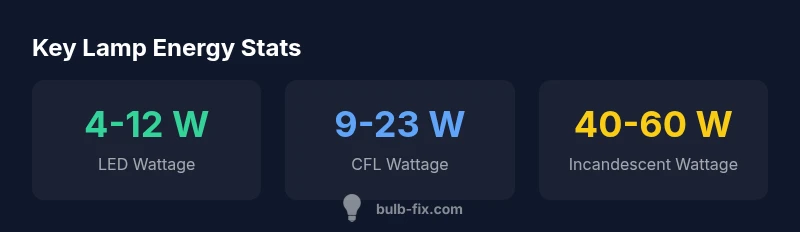
Does lamp use a lot of electricity? Not necessarily. Most lamps consume far less energy than major home appliances. Typical bulb wattages vary: LED bulbs run about 4–12 watts, CFL bulbs about 9–23 watts, and incandescent bulbs commonly 40–60 watts. Even with several lamps on, switching to LED dramatically reduces consumption and operating costs over time.
Does lamp use a lot of electricity? Understanding energy use
According to Bulb Fix, energy use from a lamp is determined not just by wattage, but by how bright you need the space (lumens) and how long you keep the lamp on. The simple question 'does lamp use a lot of electricity' has no one-size-fits-all answer. In many homes, lamps are responsible for a small share of total electricity, especially when LEDs replace older incandescents. To evaluate, compare wattage, usage time, and efficiency ratings across common bulb types: LEDs, CFLs, and incandescent bulbs. A typical LED lamp may draw 4–12 watts for standard room lighting, while a CFL might use 9–23 watts, and a traditional incandescent lamp 40–60 watts or more if higher brightness or older designs are used. If you run several lamps, the combined draw adds up, but LEDs still offer the lowest energy footprint per lumen.
-
The key to true efficiency is not just watts, but lumen output per watt (LPW). A 60-watt incandescent at 800 lumens is far less efficient than a 9-watt CFL at 800 lumens or a 10-watt LED delivering 800–900 lumens. In practical terms, replacing one or two aged bulbs with LEDs can lower energy use by 60–90% for those fixtures.
-
Understanding your current setup helps you estimate impact. If your lighting split is top-heavy with incandescent lamps in living spaces, LED replacements will yield significant savings. If most lighting is already LED or CFL, the marginal savings drop but reduce heat and replace lamp life costs. The bottom line: energy savings come from choosing the right bulb type for the task and avoiding over-lighting a space.
How bulb type affects energy draw
Energy draw is a product of wattage and usage. LEDs convert electricity into light with high efficiency, CFLs use compact phosphor-coated tubes, and incandescent bulbs rely on a filament heating up to emit light. LED and CFL options typically provide the same perceived brightness at far lower wattages than incandescent bulbs. When you evaluate a lamp, compare lumen output (brightness) rather than relying on wattage alone. A modern LED lamp that emits 800–900 lumens can replace a 60-watt incandescent in most tasks while using under 12 watts. This difference translates to substantial savings over the lifetime of the bulb, especially if the lamp stays on for hours each day.
How usage patterns influence energy consumption
Energy use is a function of both wattage and time. If you place a high-wattage bulb in a dimmable lamp and leave it on for long periods, your energy consumption will grow quickly, even if the wattage is relatively modest. Conversely, using lower-wattage LEDs for the same tasks, enabling proper dimming, and turning lights off when not needed dramatically reduces energy use. The frequency of usage and the time-of-day patterns also matter: lamps used in rooms with infrequent occupancy should be paired with motion sensors or timers to minimize waste. For households with multiple lamps, creating lighting zones and using task lighting instead of ambient lighting can cut total draw by a meaningful margin.
Real-world scenarios and cost impact
Consider common living room and bedroom setups. In a typical living room, a few lamps with LED bulbs can replace a single high-output incandescent for most tasks. For instance, a reading lamp using a 6–10W LED may provide the same brightness as an old 60W incandescent. Over a year, the energy cost difference compounds: LED usage can translate to roughly one-third to one-fifth the energy costs of incandescent usage under similar usage patterns. The exact savings depend on electricity rates in your area, hours of operation, and whether you consistently use lighting in dimmed modes. In practice, most households see noticeable reductions by adopting LED replacements and avoiding unnecessarily bright wattage for each space.
Measuring and reducing lamp energy use
Measuring energy use starts with simple tracking and a few practical changes. Replace incandescent or older CFLs with LEDs that match the required lumens. Use dimmers or smart plugs to ensure you only run lights when needed. Establish a light plan for rooms: a single overhead fixture for general light and task lamps for reading or electronics work. When evaluating a lamp, look for energy ratings and recommended lumen outputs for different tasks. A compact, well-placed task lamp can reduce the need for bright overhead lighting, further cutting energy consumption. Finally, consider timers or daylight-aware controls to adjust lighting automatically based on time and ambient light levels.
Choosing efficient lamps and fixtures
Selecting the right lamp involves more than wattage. Pay attention to lumens per watt (LPW), color rendering index (CRI), and the lamp’s compatibility with dimmers or smart controls. For energy efficiency, prefer LED lamps with high LPW that deliver adequate brightness for the intended task. Choose fixtures that minimize wasted light and direct illumination where it’s needed. When possible, use natural daylight for tasks during the day and reserve artificial lighting for evenings or low-light periods. Small changes, like replacing a single lamp with an LED version and using a lamp shade to optimize diffusion, can enhance perceived brightness without significantly increasing energy use. If you’re unsure, start with a common task lamp in the living room or bedroom and scale gradually to more rooms as you evaluate energy savings.
Common myths and practical takeaways
Myth: All bright lights consume the same energy. Fact: Lamp energy use varies by bulb type, wattage, and usage time. Myth: Higher wattage always means more brightness. Fact: Lumens measure brightness; LED lamps often deliver more lumens per watt than incandescent. Myth: Turning lights on and off wastes energy. Fact: In modern bulbs, turning lights off when not needed saves energy and reduces wear. Practical takeaway: Prioritize LEDs, use task lighting, implement dimmers, and set schedules to reduce consumption without sacrificing comfort.
Lamp energy use by type
| Lamp Type | Typical Wattage | Notes |
|---|---|---|
| LED lamp (standard) | 4-12 | Most energy-efficient option for general lighting |
| CFL lamp | 9-23 | Good efficiency; longer warm-up time |
| Incandescent lamp | 40-60 | High energy use; offers warm light |
Got Questions?
Does switching to LED automatically save money?
Yes. LEDs use far less energy for the same light output and last longer, reducing both energy costs and replacement frequency.
Yes. LED lights use much less energy and last longer, which lowers both your energy bills and replacement costs.
How many watts do I need for a lamp?
Wattage alone isn’t the full story. Look at lumens (brightness) per watt and select a bulb that provides the needed brightness with the fewest watts.
Pick brightness by lumens, not watts; a lower-watt LED can meet most needs.
Are halogen bulbs more energy-efficient than incandescents?
Halogen bulbs are more efficient than older incandescents but still consume more energy than LEDs or CFLs for the same brightness.
Halogen is better than old incandescents but not as efficient as LEDs or CFLs.
Do smart bulbs use more electricity?
Smart bulbs add a small amount of standby power for wireless features, but overall energy use remains lower than many incandescent setups when used with schedules and dimming.
Smart bulbs draw a little extra for wireless features, but saving with scheduling and dimming still helps.
Is it worth buying dimmable LEDs for energy savings?
Dimmable LEDs can save energy when you only need lower light levels. Ensure your dimmer is compatible to avoid inefficiency or flicker.
Yes, if you use lower light levels; pick compatible dimmers to maximize efficiency.
Do lamp energy costs include standby mode?
Most lamps do not draw energy when switched off. Some electronics in smart lamps may consume standby power; unplug or use smart power strips if you want to minimize this.
Standby power is usually minimal, but smart lamps can use a little; unplug or use smart strips to avoid it.
“LED lighting dramatically reduces energy use without sacrificing brightness. Pair LEDs with dimmers or smart controls to maximize savings.”
Key Points
- Choose LED lamps for the lowest energy draw
- Match lumen output to task to avoid over-lighting
- Use dimmers and smart controls to cut usage
- Turn lights off when not in use to save energy
- Consider room layout to minimize total watts