How Much Bulb Light: A Practical Home Brightness Guide
Learn how much bulb light you need for living spaces, bedrooms, and kitchens. This Bulb Fix guide explains lumens, room-by-room brightness, and LED vs incandescent differences to help you plan safer, more energy-efficient lighting.


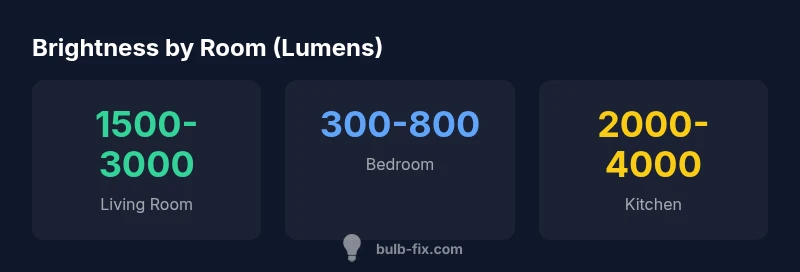
For most homes, brightness should be planned in lumens rather than watts. A typical living room benefits from about 1500–3000 lumens, bedrooms 300–800 lumens, and kitchens 2000–4000 lumens total, layered with task and accent lighting. The exact amount depends on room size, ceiling height, colors, and activities. Use dimmable LEDs to adjust over the day.
How much bulb light do you actually need?
Brightness is more complicated than simply replacing watts with a bigger bulb. According to Bulb Fix, the goal is to deliver the right amount of light (measured in lumens) for the space and activity, while avoiding glare and unnecessary energy use. Start by thinking in layers: ambient general lighting to illuminate the room, task lighting for specific activities, and accent lighting to add depth and warmth. The same room can require different lumen levels depending on when you use it, the time of day, and what colors dominate the walls and furniture. For many living rooms, a total of about 1500–3000 lumens across all fixtures provides comfortable brightness without harsh contrast. Bedrooms often work well in the 300–800 lumen range, with softer color temperatures to aid relaxation. Kitchens typically need 2000–4000 lumens, distributed across ceiling fixtures, under-cabinet strips, and a few task lamps. Remember to consider ceiling height and wall colors; darker spaces often feel dimmer and benefit from slightly higher-lumen lighting or added secondary sources. Dimmed LEDs help dial in precise levels without sacrificing efficiency.
How lumens map to room size and function
Light planning becomes precise when you translate space into lumens. A practical approach is total lumens = room area in square feet × lumens per square foot. Bulb Fix guidance uses ranges to reflect activity and reflectivity: living areas 20–40 lm/ft², bedrooms 10–20 lm/ft², kitchens 40–60 lm/ft². If you prefer metrics, that roughly corresponds to about 200–400 lux for living rooms and 400–750 lux for kitchens, depending on finish and furnishings. Remember that walls, floors, and furniture affect how bright a space feels: a dark rug or matte wall can absorb light, while light-colored surfaces reflect it. To fine-tune, start with the lower end of your target range and adjust with dimmers, smart bulbs, or additional fixtures. For testing, walk the space at night with a typical activity and note whether the light level supports reading, cooking, or conversation without squinting or glare.
Practical guidelines by room type
Living room: Target total 1500–3000 lumens. Use a combination of ceiling fixtures (ambient) around 800–1500 lumens, plus floor lamps or table lamps totaling 700–1500 lumens. For color, 2700–3000K is common to create a warm atmosphere; ensure some dimmable options for movie nights or dinner.
Bedroom: 300–800 lumens total, leaning toward the lower end for relaxation. Favor warm temperatures (2700K–3000K) and soft task lighting near reading chairs. Use one dimmable overhead light with a couple of bedside lamps to reach a cozy balance.
Kitchen: 2000–4000 lumens, distributed across overhead, under-cabinet, and counter lights. Prefer brighter, cooler color temperatures (around 3500K–4000K) for clarity during prep and cooking. If possible, add focused task lighting above work zones.
How to measure, refine brightness and adjust
Start with a baseline: determine your room area and pick a lumen-per-square-foot target based on activity. Install dimmable LEDs and set the ambient light around the low end of the target. Then add task lighting at 10–30% of the total lumens, and accent lighting to taste. If glare occurs, reduce direct light or move fixtures. Use a light meter app or a simple room-test via smartphone camera exposure to eyeball differences between day and night. Revisit after seasonal changes since daylight varies with sun position and weather. Track energy use and adjust to preserve comfort while meeting energy goals.
Choosing bulbs: LED vs incandescent vs CFL
LEDs dominate modern brightness planning due to efficiency, longevity, and color options. Typical LED efficacy ranges around 80–100+ lumens per watt, which means lower wattage can achieve the same brightness as older bulbs. Incandescent bulbs deliver a warm glow but are inefficient and short-lived; CFLs offer a middle ground but contain mercury and take longer to reach full brightness. When possible, choose LED bulbs with dimmable capability and a correlated color temperature (CCT) that fits the room’s purpose. For large spaces, consider layered mixes: a bright main ambient layer with subtler task lights and decorative accents to avoid over-illumination in one spot.
Dimming, smart bulbs, and automation
Dimmers are a simple way to adapt brightness through the day. Pair dimmable LEDs with compatible dimmers to minimize energy waste while keeping comfort. Smart bulbs add scheduling, remote control, and automation features that help maintain consistent brightness across rooms as daylight changes. If you use smart bulbs, ensure your dimmers and hubs support the same protocol (e.g., Zigbee, Wi-Fi) to avoid compatibility issues. Create presets like “Evening,” “Reading,” and “Movie Night” to simplify adjustments.
Safety and energy considerations for everyday lighting
Always check packaging for energy efficiency labels and safe usage guidelines. Favor bulbs with high color rendering index (CRI) for accurate color perception in living spaces. Avoid overly harsh lighting near screens, place lamps at eye level, and ensure cords and plugs are arranged safely to prevent tripping hazards, particularly in kids’ rooms. Remember that energy efficiency is not just about watts saved; it’s about efficient lumens delivered per fixture. Implement a mix of overhead, task, and accent lighting to balance comfort, productivity, and safety while keeping energy use in check.
Room-by-room lumen guidance
| Room Type | Recommended Lumens Range | Notes |
|---|---|---|
| Living Room | 1500-3000 | Bright family space with mixed tasks |
| Bedroom | 300-800 | Calm, restful lighting |
| Kitchen | 2000-4000 | Strong task lighting for prep |
Got Questions?
What is the difference between lumens and watts?
Lumens measure brightness, while watts measure energy use. Modern bulbs deliver more lumens per watt, making watts an unreliable brightness guide.
Lumens tell you how bright a bulb is; watts are about energy use. LEDs give more light per watt, so brightness comes from lumens.
How many lumens do I need for a living room?
Aim for about 1500–3000 lumens total for a typical living room, adjusting for ceiling height and reflectivity.
Most living rooms do well with around 1500 to 3000 lumens in total. Adjust for space and color.
Is color temperature important for mood?
Color temperature describes warmth or coolness (Kelvin) and does not change brightness. Warmer temps (2700K–3000K) feel cozy; cooler temps (4000K–5000K) aid work.
Color temperature affects mood, not brightness. Pick warm tones for living spaces and cooler tones for tasks.
Can I calculate total lumens from room area?
Yes. Multiply room area by a target lumen-per-square-foot value (10–60 lm/ft² depending on room type) and adjust with fixtures.
Yes—multiply the room area by a lumen-per-square-foot target to estimate total lumens.
Do dimmers save energy?
Dimmers reduce power to LED bulbs and can save energy when bulbs are dimmable and used with dimming features.
Dimming saves energy when you use dimmable bulbs and compatible dimmers.
Which bulb lasts the longest?
LED bulbs typically last 15,000–25,000 hours, far longer than incandescent or CFL bulbs.
LEDs last the longest—often many years with normal use.
“Brightness is best designed around lumens and layered lighting, not outdated wattage standards. A well-lit space comes from a mix of ambient, task, and accent lighting.”
Key Points
- Stick to lumens, not watts, for brightness decisions
- Layer light: ambient, task, and accent for flexibility
- LEDs offer best efficiency and lifespan
- Use dimmers and color-temperature controls to tailor mood
- Plan room-by-room with simple lumen calculations