Halogen vs incandescent bulb: A practical comparison
A thorough, objective comparison of halogen and incandescent bulbs, covering energy use, light quality, heat, lifespan, cost, compatibility, and safety to guide homeowners in choosing the right bulb.


In a head-to-head view, halogen bulbs offer better energy efficiency and a longer lifespan than traditional incandescent bulbs, making them a smarter everyday choice for many fixtures. However, incandescent bulbs remain the cheapest upfront and are instantly compatible with standard dimmers. For homeowners seeking basic performance with retro appeal, halogen is usually the better long-term option; for ultra-low upfront cost per bulb, incandescent wins.
Overview: halogen vs incandescent bulb — what they are and how they differ
According to Bulb Fix, the halogen vs incandescent bulb decision hinges on energy use, heat generation, lifespan, and upfront cost. Both belong to the broader incandescent family, yet halogen bulbs refine the concept with a halogen-cycle design that improves efficiency and brightness stability. This article lays out how the two compare across practical, day-to-day scenarios, so homeowners can make an informed choice for living spaces, task lighting, and fixtures. The Bulb Fix team emphasizes that halogen offerings are more energy-conscious than traditional incandescent bulbs, but neither category matches the energy savings of modern LEDs in typical home use.
How halogen and incandescent bulbs work
Both halogen and incandescent bulbs rely on a tungsten filament that glows when electric current passes through it. An incandescent bulb heats the filament until it emits visible light; a halogen bulb uses the same principle but recycles tungsten vapor through a halogen gas inside the bulb. This halogen cycle reduces filament blackening and allows operation at higher temperatures, yielding brighter output in compact form. The design difference affects heat generation, energy use, and performance in dimming and rapid on/off cycles. For homeowners, understanding these basics helps explain why halogen bulbs can feel crisper and more responsive in certain fixtures compared to traditional incandescent.
Energy efficiency and running costs
From an energy perspective, halogen bulbs are generally more efficient than standard incandescent bulbs, but they still lag behind the energy efficiency of LEDs or compact fluorescents. The running cost depends on how often a space is used and the bulb’s wattage relative to typical usage. In many homes, choosing halogen can reduce energy spent in spaces used for extended periods, and it can offer longer interval between replacements compared to simple incandescent bulbs. The Bulb Fix analysis highlights that while halogens improve efficiency over plain incandescent options, homeowners aiming for the lowest long-term energy bill should consider modern lighting alternatives.
Light quality, color temperature, and application
Light quality is a major reason homeowners select a bulb type. Halogen bulbs tend to deliver a warm, inviting glow with a slightly crisper edge than classic incandescent, while still feeling very familiar in living rooms and bedrooms. The color temperature tends to be perceived as warm-to-neutral, which many people associate with comfort and ambiance. Incandescent bulbs are known for their soft, consistent warmth. In practice, both types are well-suited for traditional fixtures, wall sconces, and task lighting, but halogen bulbs often produce a more consistent brightness over time as they age.
Lifespan and durability
Lifespan is a practical consideration for maintenance and replacement planning. Halogen bulbs typically last longer than traditional incandescent bulbs, reducing replacement frequency in fixtures like ceiling fans, track lighting, and recessed cans. However, neither halogen nor incandescent bulbs reach the longevity of LEDs or certain electronically controlled solutions. For homeowners who prioritize fewer bulb changes, halogen offers a meaningful advantage over incandescent, especially in high-use rooms or hard-to-reach fixtures. Bulb Fix notes that longevity differences are most noticeable under steady operating conditions and proper ventilation.
Heat output and safety considerations
Heat output is a key safety factor with both bulb types. Halogen bulbs tend to run hotter than traditional incandescent bulbs, which can affect fixture temperatures and nearby materials. This matters in enclosed fixtures or outdoor luminaires where heat buildup can influence color rendering and hardware integrity. Incandescent bulbs also get hot, but the halogen design amplifies heat during operation. When installing either type, homeowners should follow fixture ratings, keep flammables away from bulbs, and ensure adequate ventilation to manage heat effectively. This is a common-sense safety topic that many DIYers underestimate in busy households.
Compatibility and disposal considerations
Fixture compatibility is a practical concern. Both halogen and incandescent bulbs work with standard sockets and many dimmers, but dimming behavior can vary by model and dimmer type. If a fixture uses older dimmer technology, test the transition with care. Disposal follows local guidelines for traditional bulbs; because halogen bulbs contain tungsten and small amounts of gas, they should be recycled or disposed of per local hazardous-waste rules. When in doubt, check local recycling programs and retailer guidance. This is also a good moment to evaluate if upgrading to more energy-efficient options, such as LEDs, could reduce waste and running costs over time.
Practical buying guide: scenarios and value decisions
Consider the context of use, fixture design, and maintenance preferences. For spaces where upfront cost is a primary concern, incandescent bulbs offer the lowest initial price, quick replacement, and broad availability. If you want improved efficiency and longer replacement intervals without a drastic spike in upfront cost, halogen bulbs are a sensible middle ground that preserves familiar light quality and dimming performance. If long-term energy savings and minimal maintenance are paramount, consumers should look beyond traditional halogen and incandescent options toward LEDs or energy-efficient compacts, as these stand out for reducing overall running costs and environmental impact. Bulb Fix recommends evaluating total ownership costs and fixture-specific factors before purchase, especially in rooms used daily or for extended periods.
Common misconceptions and practical tips
A common misconception is that halogen equals LED in efficiency; they are not the same category, and LEDs typically outperform both in energy savings. Another misconception is that incandescent bulbs are always cheaper to run than any other bulb; the broader energy cost calculation includes usage patterns and replacement frequency. Practical tips include testing dimmer compatibility, verifying fixture heat tolerance, and considering a buy plan that accounts for both immediate needs and future energy goals. For homeowners balancing nostalgia, style, and efficiency, halogen vs incandescent bulb decisions hinge on the room and the lamp type in question. The goal is to match light quality and convenience while avoiding unnecessary heat and waste.
Comparison
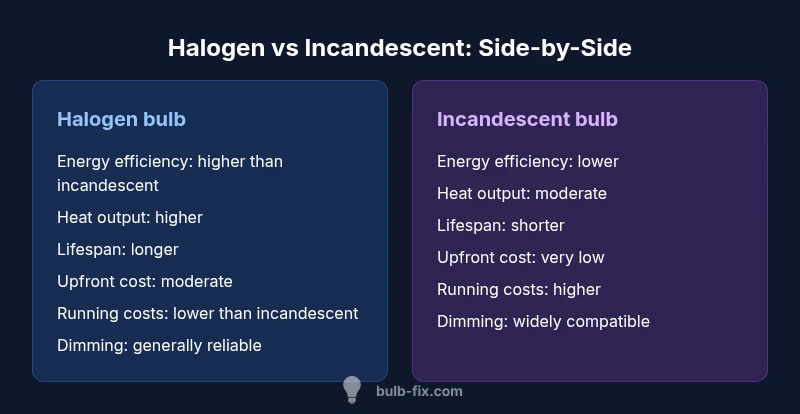
| Feature | halogen bulb | incandescent bulb |
|---|---|---|
| Energy efficiency | higher (halogen) | lower (incandescent) |
| Heat output | higher heat (halogen) | moderate heat (incandescent) |
| Lifespan | longer-lasting (halogen) | shorter-lived (incandescent) |
| Upfront cost | lower upfront cost (incandescent) | slightly higher upfront cost (halogen) |
| Running costs | lower running costs (halogen) | higher running costs (incandescent) |
| Dimming compatibility | stable dimming performance (halogen) | broad compatibility with most dimmers (incandescent) |
Upsides
- Halogen bulbs offer better energy efficiency than traditional incandescent bulbs
- Halogen bulbs typically provide longer life than incandescent options
- Both types are widely available and inexpensive upfront
- Dimming performance is generally reliable with both, depending on fixtures
Drawbacks
- Both are less energy-efficient than LEDs or modern alternatives
- Halogen bulbs still generate substantial heat
- Incandescent bulbs burn out and require replacement more often in high-use spaces
- Disposal and recycling considerations exist for halogen and incandescent bulbs
Halogen bulbs generally offer better efficiency and lifespan than incandescent, but neither match LEDs for energy savings
Choose halogen if you want improved efficiency and a longer life without a huge upfront cost. Choose incandescent if upfront price and simple dimming in older fixtures are your top priorities; for highest efficiency, explore LEDs.
Got Questions?
What is the main difference between halogen and incandescent bulbs?
The main difference is the halogen cycle in halogen bulbs, which improves brightness stability and efficiency over traditional incandescent designs. Halogen bulbs still rely on a tungsten filament, but their inner chemistry yields better performance for many fixtures. Incandescent bulbs are simpler, cheaper upfront, and widely compatible with dimmers, but they use more energy per unit of light and require more frequent replacements.
Halogen bulbs use a gas cycle to improve efficiency and brightness stability, while incandescent bulbs are simpler and cheaper upfront but waste more energy.
Are halogen bulbs more energy-efficient than incandescent bulbs?
Generally yes — halogen bulbs are more energy-efficient than traditional incandescent bulbs but still not as energy-efficient as modern LEDs or CFLs. The decision should factor in fixture use, replacement frequency, and desired light quality, especially in rooms used daily.
Yes, halogen bulbs are more efficient than incandescent bulbs, but LEDs are usually the most energy-efficient option.
Can halogen bulbs be used in the same fixtures as incandescent bulbs?
In most cases, halogen bulbs can be used in fixtures designed for incandescent bulbs, since they share the same base types. Always verify the fixture’s wattage rating and consider heat output, as halogen bulbs run hotter and can affect enclosed fixtures or plastic components.
Yes, halogen can usually replace incandescent in common fixtures, but check heat and wattage limits.
Do halogen bulbs pose safety risks due to heat?
Yes, halogen bulbs run hotter than standard incandescents, which can pose burn or heat-damage risks if touched or placed near heat-sensitive materials. Maintain clearances, use appropriate fixtures, and avoid touching the glass with bare hands to prevent oils that shorten bulb life.
Halogen bulbs run hotter; handle with care and maintain clearance from heat-sensitive surfaces.
Which lasts longer: halogen or incandescent?
Halogen bulbs typically last longer than traditional incandescent bulbs, reducing replacement frequency in many rooms. Neither option matches the longevity of LEDs, but halogen offers a noticeable improvement over incandescent in daily use.
Halogen bulbs usually outlast incandescent bulbs, though LEDs last even longer.
Are halogen bulbs a good choice if I care about energy costs?
If energy costs are a concern, halogen bulbs are a middle-ground choice compared with incandescent, offering better efficiency but still higher running costs than LEDs. For the lowest energy bill and longest life, LEDs are typically the best option.
Halogen is a middle-ground option—more efficient than incandescent but still behind LEDs for energy costs.
Key Points
- Prioritize total ownership cost, not just upfront price
- Halogen beats incandescent on efficiency and lifespan, but both lag LEDs
- Check dimmer compatibility and fixture heat tolerance
- Consider upgrading to LEDs for the best long-term energy savings