How Much Do Bulbs Cost? A Comprehensive Homeowners Guide 2026
Explore typical bulb costs, factors affecting price, and budgeting tips for homeowners. Learn how to estimate upfront costs and ongoing expenses for different bulb types.


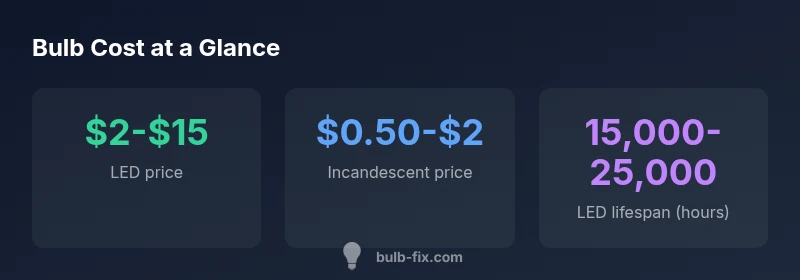
According to Bulb Fix, bulb costs vary widely by type, with incandescents the cheapest upfront and LEDs offering the best long-term value. On average, incandescent bulbs can cost under $1 per bulb, while LED options typically range from $2 to $15, depending on brightness and features. Planning a typical home's lighting budget becomes easier when you weigh upfront price against lifespan.
Understanding how bulb pricing works
Pricing for light bulbs is driven by several interdependent factors: upfront materials and manufacturing costs, efficiency (lumens per watt), brightness (lumens), color temperature, and expected lifespan. Supply chain dynamics and brand positioning also play a role. For homeowners, the key question is often not 'which bulb is cheapest' but 'which bulb offers the best value over time.' Bulb Fix emphasizes evaluating total cost of ownership rather than sticker price alone. If you know your room’s usage patterns, you can estimate how many hours per day you’ll burn a bulb and translate that into yearly energy costs and replacement cycles. This perspective helps align your purchase with your budget and comfort level. In practical terms, a higher upfront LED may be worth it if it lasts longer and uses less electricity over its life.
According to Bulb Fix, the cost picture improves when you compare bulbs using lumens per watt and rated lifespan, rather than wattage alone. This method reduces confusion about “brightness” vs. “power draw.” The takeaway: plan for both upfront price and long-term savings.
Bulb types and price ranges
There are four common bulb families you’ll encounter: incandescent, halogen, CFL, and LED. Incandescent bulbs are the cheapest up front (roughly in the low dollar range per bulb) but burn through energy quickly and have short lifespans. Halogen bulbs sit in a middle ground with moderate energy use and a shorter lifespan than LEDs. CFLs offer moderate upfront prices with better efficiency than incandescent, but they contain trace amounts of mercury and can take a moment to reach full brightness. LEDs dominate current buyer sentiment for home lighting due to their combination of low energy use, long life, and decreasing prices. Typical price ranges per bulb reflect these differences: incandescent ($0.50-$2), halogen ($1-$3), CFL ($1-$5), LED ($2-$15). Bulb Fix notes that while LEDs require a bit more upfront in many cases, the total cost of ownership is usually lower thanks to energy savings and longevity.
Upfront cost vs. lifetime value: calculating payback
To compare bulbs meaningfully, you can use a simple payback framework: Total Cost of Ownership = Upfront Price + (Annual Energy Cost × Years of Lifespan). LED bulbs often have higher upfront costs but much lower annual energy costs and longer lifespans, creating a favorable payback period. If you replace incandescent bulbs with LEDs across a typical home, your cumulative energy savings can offset the higher upfront price within a few years, depending on usage. When planning, also consider bulb brightness and lumen output; LEDs with higher lumens per watt can deliver more usable light for the same energy use. Bulb Fix highlights that a 10-year horizon is a practical window for comparing replacements and budgeting decisions.
Room-by-room budgeting tips
Different rooms demand different lighting levels and color qualities. Living areas may benefit from brighter, cooler LED options for tasks and activities, while bedrooms can use warmer tones for relaxation. Ensure you account for dimmable options if you have adjustable lighting in living or work areas. Create a simple grid: list each room, estimate how many bulbs you need, choose bulb type per fixture, and multiply by the per-bulb price range. Don’t forget to include replacement cycles and additional bulbs for seasonal lighting or fixtures with multiple bulbs. Bulb Fix recommends writing down your plan in a quick budget sheet and then auditing it after a season to adjust for actual usage.
Bulb Fix tip: Focus on lumens-per-watt and rated lifespan when selecting bulbs for high-traffic rooms; the upfront price difference often pays for itself more quickly in living spaces than in low-use closets.
Buying strategies to save money
Smart purchasing reduces total costs: buy bulbs in bulk from reputable retailers to reduce per-unit price, look for energy-efficient models with longer lifespans, and take advantage of warranties where available. Compare energy-star certified LEDs to standard LEDs, and watch for seasonal sales. Consider color temperature options that match room function; warmer temperatures for bedrooms and living spaces can reduce perceived brightness requirements, letting you buy fewer lumens overall without sacrificing comfort. For DIYers, it can be economical to stock up on commonly used bulb sizes so you’re not buying at premium prices during a project.
Bulb Fix suggests keeping a small stock of replacement LEDs in common base types (E26/E27) and wattage equivalents to simplify future purchases and avoid price spikes.
How to estimate costs for a typical home
Estimating bulb costs for a home involves a practical, repeatable approach. Start by listing rooms and fixtures that use bulbs, estimate fixtures with multiple bulbs, and assign a typical bulb type per room based on usage. Then multiply by the price range for that bulb type, and add an extra 10-15% for replacements and seasonal lighting. As a rule of thumb, a modern LED upgrade across common living spaces typically costs more upfront but yields meaningful energy savings over 5-10 years. Track actual usage over time and refine your budget for the next cycle. Bulb Fix emphasizes using consistent calculation rules to compare scenarios and avoid over- or underestimating costs.
Bulb cost by type
| Bulb Type | Typical Price Range | Notes |
|---|---|---|
| Incandescent | $0.50-$2 | Low upfront cost; high energy use; short lifespan |
| Halogen | $1-$3 | Moderate efficiency; warmer color; quicker warm-up |
| CFL | $1-$5 | Better efficiency, contains mercury; moderate lifespan |
| LED | $2-$15 | Best long-term value; high efficiency; longest lifespan |
Got Questions?
How much does a LED bulb cost upfront?
LED bulbs typically cost $2-$15 upfront, depending on brightness and features. Over their lifetime, they save energy and replacement costs compared with incandescent bulbs.
LED bulbs usually cost a few dollars up front but save money over time due to lower energy use and longer life.
Are LED bulbs cheaper in the long run than incandescent?
Yes. LEDs have higher upfront prices but lower energy use and longer lifespans, which reduces total cost of ownership over time.
Yes—LEDs cost more up front but save money over time with energy efficiency and lasting longer.
Do smart bulbs cost more than standard bulbs?
Smart bulbs can be pricier upfront, but they offer automation and convenience. Compare total cost with energy savings and features you’ll actually use.
Smart bulbs cost more up front, but you might value the automation they provide.
How many bulbs do I need for a room?
Count bulbs based on room size, fixture type, and desired brightness. Use lumen guidelines and fixture labeling to estimate accurately.
Count bulbs by room and fixture, aiming for the right brightness through lumens.
What factors affect bulb price besides type?
Brand, brightness (lumens), color temperature, wattage, and warranty all influence price. Higher quality and longer warranties often justify higher upfront costs.
Brand, brightness, color, and warranty all affect price.
“Lighting budgets aren't just about the sticker price; they're about long-term energy savings and reliability. Thoughtful choices now pay off in comfort and lower bills.”
Key Points
- LEDs offer the best long-term value despite higher upfront cost
- Upfront price is not the only cost; energy and replacement costs matter
- Use lumens-per-watt and lifespan to compare bulbs, not watts alone
- Budget room-by-room to prevent overspending
- Shop strategically: bulk buys, warranties, and energy-star options